Readers Note: This essay contains plot details
By Brant Short
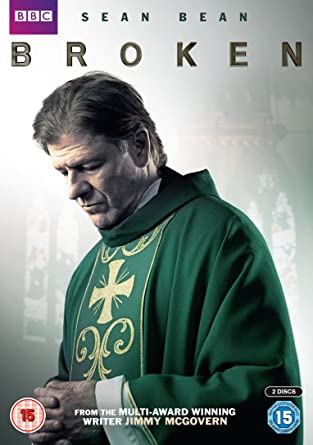
Broken is a six-episode series that aired on BBC in 2017. It tells the story of Father Michael Kerrigan, a Catholic priest in an urban parish set in the north of England. The industrial city, near the ocean, is not revealed but it is clear that it has suffered economic hardship and all the problems that face any big-city neighborhood. Typically associated with action heroes in film, Sean Bean plays Father Kerrigan with an emotional range that can be subtle and hesitant, but with an abiding faith that never becomes zealotry and blind allegiance. He brings humanity to a character who sometimes seems distant and troubled, yet is able to call forth our own empathy for both the priest and the lost souls he counsels.
Broken does what television does best, it tells a compelling story with enough time for depth and breadth of character development and narrative complexity. Like a powerful novel, the film uses the life of Father Kerrigan and several members of his community to reveal existential crises people face on a daily basis. Each episode focuses on a central character’s struggles, but it does not become a series of individual self-contained stories. The episodes function as chapters that reveal connections among the characters and Father Kerrigan’s efforts to help.
The people who come to Father Kerrigan suffer from the kind of problems not solved with advice or prayer. They are pushed to the edge, mentally, economically, and socially. Addiction, mental illness, discrimination, poverty, and other social ills threaten his working-class community. Some are faithful members of his congregation and others not connected to the church who seek spiritual help.
In the first episode, a single mother, working in a dead-end job, struggles to provide for her three children. When a crisis occurs, the mother makes an ethical decision that has legal consequences, a decision grounded in trying to find enough money to pay the rent and buy food for her family. Subsequent episodes center on different members of the community who are experiencing life crises. A police officer is confronted with telling the truth or being ostracized by his entire unit when an arrest ends in a death. A mother seeks help for her adult son who is experiencing mental illness. A gay man is threatened by violent neighbors which they justify by Christian fundamentalism. A woman who committed a crime shares her plan to commit suicide and asks Father Kerrigan to promise not to intercede.
Structurally, each episode has a central character in a specific conflict, but as the series unfolds the characters and their interaction with Father Kerrigan connect in seemingly random ways. Father Kerrigan is helpful, optimistic, supportive, but also frustrated, confused, and angry. He begins each day with hope but is often emotionally and physically spent by day’s end. We learn that his own life has been harsh and others have sinned against him. But he also admits his own sins of both action and omission over the course of his life. He attempts to understand his past but a nagging sense of failure seems always present, especially when he presides over worship and celebrates communion.
This is a story of faith told from a mature, realistic, and compelling perspective. Like many who grow up in organized religion and come to question its place in their life, Father Kerrigan too has doubts about his worthiness to be a priest and failure to help those in the greatest need. Ironically, we learn that his efforts do make a difference for people, but not in the tradition of a mythic hero who slays dragons, punishes evildoers, and restores order. Father Kerrigan’s work to help others is messy, emotional, and incomplete. He strives to make a difference in his world but it is never enough for those suffering and more importantly never enough for himself. The essential difference eventually becomes clear in the final minutes of the final episode.
Broken does double duty as a title. Obviously, the people in Father Kerrigan’s community are broken by the forces of darkness that plague much of the world (addiction, discrimination, poverty, etc.) and the church is supposed to offer help for those broken souls. We also see “broken” as central to Father Kerrigan’s celebration of the Eucharist, when he offers broken bread as a remembrance of the body of Christ. However, there is even a deeper layer of meaning, Father Kerrigan suffers emotional attacks, close to blackouts, as he offers the prayers of communion as the culmination of worship. He too is broken and the language of the body and blood of Jesus Christ prompt anxiety attacks that are nearly debilitating.
While this is Father Kerrigan’s story, much of the time we see other characters living through their own daily struggles, not through the eyes of the priest. In contrast, we usually see Father Kerrigan working in his church setting. We see him leading worship, meeting individuals in the church itself, going to meetings in church office space, or seeking relaxation in his living quarters connected to the church. He always wears his clerical collar (except for the few times he is visiting his mother or drinking with his brothers). For the most part, Father Kerrigan is always on duty and even with his family his role as priest is always present.
Broken tells the story of the fragility of faith in a chaotic, unpredictable, and dangerous world and what compels people to seek comfort, solace, and help in the confines of organized religion. This is not the story of an activist priest who fights injustice on street corners or in the halls of government. Instead, we see the hard work of emotional labor, meeting people in their pain and suffering, and offering them a chance to share, and hopefully work through, their problems with advice, prayer, and ultimately the unconditional presence of another person. He often sees little evidence of success in helping others, but viewers come to understand that Father Kerrigan’s life is meaningful in the larger context of his mission: to help others, with the presence of God, regardless of the spiritual beliefs and practices of those in need.
Broken is more than a story about a Catholic priest in England struggling to help his flock. It examines how those who are entrusted to help vulnerable people (teachers, nurses, counselors, police officers, religious leaders, and so forth) must confront and manage their own inner voice of struggle, depression, even anger, and continue to slog through another day of helping others knowing that the next day will be more of the same.
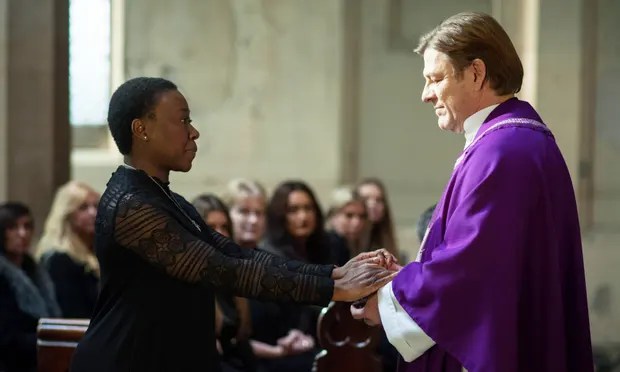
The last 15 minutes of Broken offer a powerful sense of closure with a number of issues coming to the surface. A beautiful piece of music, (“A Silent Prayer” by Ruth Barrett) creates a sense of serenity in the most emotional of all church services: a funeral. In leading worship, Father Kerrigan again confronts his own personal struggles with family and faith and the ultimate meaning of his life. In the end, Father Kerrigan receives his own form of redemption, coming in the voice of a child taking communion: “Amen, you wonderful priest.”

 Critical Rewind