Readers Note: This essay contains plot details
Brant Short
Santa Claus may be the most recognized image of the Christmas holiday, even more well-known than images surrounding the birth of Christ. Celebrating Christmas has become a cultural event, with Santa becoming one of its iconic symbols. Christmas has become a “season” that begins in October (and earlier for some) and shapes many aspects of popular culture, commerce, and travel.
For many people, three ideals define Christmas, regardless of one’s faith and beliefs. Christmas offers a communal time for gatherings of friends and family. Although other holidays may include family and friends, December 25 has a unique place in Western culture for celebrating the blessings of life, whatever they might be. In addition, Christmas promotes a norm of sharing gifts, tangible symbols to acknowledge the importance of others in our life. Finally, Christmas highlights the importance of giving children a sense of belonging and hope.
Santa Claus often personifies these ideals in various ways he is presented in popular culture, including film and television. Cinematic versions of Santa often have several common elements. Santa exudes compassion and understanding with a touch of mysticism. He refuses to accept the cynical views of unbelievers and in turn helps them find the true spirit of Christmas. Because Santa somehow knows our fears, experiences and secrets, he also knows what we need for happiness.
The archetypal cinema Santa is most likely Kris Kringle from Miracle on 34th Street. The 1947 film presented a cinematic Santa that has served as a touchstone for generations of viewers and filmmakers. Set in New York City, the “real” Santa is named Kris Kringle, a kindly old gentleman who works as a department store Santa. Kris helps a young girl who does not believe in Santa learn the true meaning of Christmas, even in the midst of adults who reject Santa’s existence. Kris Kringle displays kindness and compassion, even when challenged from many quarters. Kris appears to have a supernatural gift; knowledge of what people really need as well as the means to achieve happiness.
One can find multiple lists of the “best” cinema Santas on the internet, often with a focus on the individual actor playing Santa. Although many of these Santas offer unique and entertaining ways to understand Christmas, two Santa stories stand out for me: “The Night of the Meek”, a 1960 episode of The Twilight Zone and Fred Claus, a 2007 film.
Like other cinematic portrayals of Santa Claus, “The Night of the Meek” and Fred Claus explore the misplaced values and practices that often shape contemporary views of Christmas. But a closer consideration of the two stories suggests something deeper, a critique that goes to the heart of what Christmas should mean and challenges viewers to become self-reflective regarding their own approaches to the holiday.
“The Night of the Meek” The Twilight Zone (1960)

In season two of The Twilight Zone, Rod Serling wrote a Christmas episode consistent with his penchant for social critique. Starring Art Carney as Henry Corwin, a down-on-the-luck department store Santa Claus, “The Night of the Meek” confronts the tension between the ideals of Christmas and the reality of the holiday’s focus on consumption and materialism.
Unlike the kindly and all-knowing department store Santa in Miracle on 34th Street, Corwin is embittered and angry, clearly intoxicated before going to work as Santa Claus in a crowded department store on Christmas Eve. Stumbling down the street, he falls and is confronted by two children who ask for various toys and then ask for a turkey for Christmas dinner and finally “please Santa, a job for my daddy.” This interaction only reinforces his downward spiral as he heads for work.
But before he can get seated and interact with the children, Corwin slips and falls. A pretentious boy calls out that Santa is “loaded” and his mother in turn creates a scene. Trying to mollify the irate customer, Corwin’s supervisor fires him on the spot. A store full of children and parents witness Corwin’s effort to apologize for his behavior. He observes that “I can either drink or weep and drinking is so much more subtle.” But he continues, in an effort to explain the larger truth of Christmas hypocrisy.
He offers a simple yet eloquent indictment of celebrating Christmas in a world filled with poverty and economic disparity. Acknowledging that his drinking was wrong, Corwin notes that he was not rude to the mother and explains he only wanted to “remind her that Christmas is more than barging up and down department aisles and pushing people out of the way.” Indeed, Corwin believes that “someone has to tell her that Christmas is another thing finer than that, richer, finer, truer and it should come with patience, and love, charity, compassion. That’s what I would have told her is she had given me a chance.”
Calling himself an “aging purposeless relic of another time”, Corwin explains that he lives in a “dirty rooming” house on a street “filled with hungry kids.” The only thing that might come down their chimney on Christmas Eve is “more poverty.” He drinks to help forget where he lives and to imagine living at the North Pole with the neighborhood children as his elves. His only wish is that one Christmas “that I could see some of the hopeless ones and the dreamless one just Christmas. I’d like to see the meek inherit the earth. And that’s why I drink and that’s why I weep.”
Returning to the tavern, the bartender tells him to get lost and he wanders into a deserted alley, only to find a stray cat and bag filled with garbage. Sleigh bells ring and the bag is somehow transformed into a bag of presents. But not only presents, but the exact present each person requests. Becoming a real Santa, Corwin passes out gifts to the street children and heads for Christmas Eve service at the Salvation Army. While the poor and disposed are happy to receive his gifts, others question Corwin’s honesty. The Salvation Army leader, a police officer, and his former supervisor assume that Corwin’s bag is filled with stolen merchandise. Only through the magic of Christmas do the unbelievers come to see the truth. As he completes his task and has an empty bag, Corwin is asked by one of the men at the shelter what he would like for Christmas. Corwin does not wish for gifts, “I only wish I could do this every year.” As the story ends, we see that Corwin is granted his wish.
Rod Serling gets the final word, as his typical in each episode of The Twilight Zone:
A word to the wise to all the children of the twentieth century, whether their concern be pediatrics or geriatric, whether they crawl on hands and knees and wear diapers or walk with a cane and comb their beards. There’s a wondrous magic to Christmas and there’s a special power reserved for little people. In short, there’s nothing mightier than the meek. And a Merry Christmas to each and all.
In “The Night of the Meek” Santa is presented as a failure, indeed a fraud, for those living on the margins. Corwin says he can only weep for those forgotten by society, the only thing they will get for Christmas is more poverty. By the same token, Corwin drinks to forget the economic disparity that is highlighted by the holiday.
The excess of Christmas celebration, shown in an active department story filled with toys, children, and well-to-do parents is in contrast with children on the street, only seeking food for the family and a job for a parent. Beyond the department store, the rest of the episode takes place in an urban neighborhood, where we see the trappings of a difficult life. Children outside in the snow, looking for help. A Salvation Army shelter filled with men with little hope. A police station. A tavern with three patrons, one passed out, drinking to welcome Christmas.
Only through the spirit of Christmas do we encounter the holiday’s real meaning: to share our world of plenty with those in need and embrace its foundational values of love, charity and compassion. Serling’s final words underline his message. Christmas reserves its “special power” for the “little people.” Importantly, Serling believes that all people need to embrace the power of Christmas, whether they wear diapers or walk with canes, whether their concern may be “pediatrics or geriatrics” he is addressing them. Christmas should be a time to honor the “meek” of the world and allow them to share in the bounty so many others take for granted.
Although Serling was not considered an active Christian, he obviously understood the power of scripture as a means of sharing an idea most Americans in 1960s would be familiar with. He is referencing the biblical book of Mark (chapter 5, verses 2-11), better known as the “Sermon the Mount.” More specially, the claim that the “meek will inherit the earth” is found in a larger section that considers both economic and spiritual poverty that many people face.
Blessed are the poor in spirit, for theirs is the kingdom of heaven.
are those who mourn, for they shall be comforted.
Blessed are the meek, for they shall inherit the earth.
Blessed are those who hunger and thirst for righteousness, for they shall be satisfied.
Blessed are the merciful, for they shall receive mercy
While theologians can assess the deeper cultural and religious implications of this passage, I believe that Serling wanted this particular verse to serve two functions. At one level, it articulates the disconnect between how Americans in 1960 celebrated Christ’s birth with the values preached by Jesus. At another level, by calling Christmas Eve the “night of the meek” the story suggests it can be the time and place for transformation, if only people are willing to change.
Fred Claus (2007)
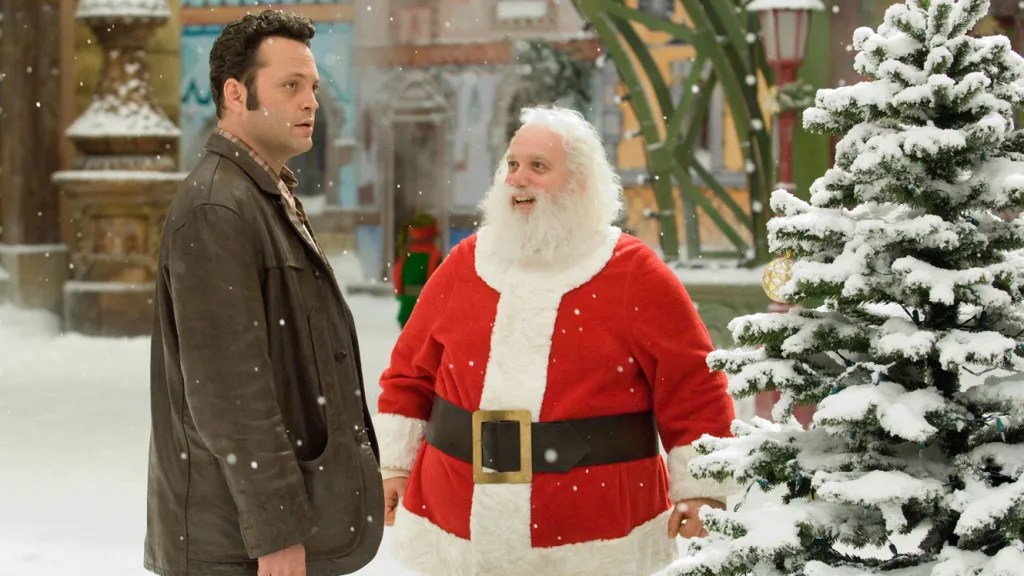
Fred Claus fulfills many of the conventions of the Santa Claus narrative. Santa is threatened in his effort to continue delivering presents on Christmas eve. Santa has a supportive spouse and hard-working elves who will do anything to help him deal with such challenges. Santa encounters and helps an embittered/cynical person understand the real meaning of Christmas. Santa saves Christmas for one more year. Except in Fred Claus Santa does not really save Christmas, his older brother Fred is the hero who steps in when Nick is incapacitated on Christmas Eve.
On the surface, Fred Claus is a predictable Hollywood effort to produce a Christmas film with a unique hook. Telling a familiar story through the eyes of Santa’s brother, the film still centers on fulfilling Santa’s mission to deliver presents, amidst a crisis, to all the good children of the world. But a closer examination of the film reveals a commentary on family, friendship, and unconditional love that transcends the Santa narrative.
The film opens in a fairy tale world of a cozy family cottage set in a beautiful forest. We see the birth of Nicholas and his special place in the world. Not only is he the “fattest” baby ever seen by the midwife, but he does not cry. A smiling newborn, he utters his first words, “Ho….Ho, Ho.” Holding the newborn infant, Nick’s mother establishes his life trajectory: “He’s perfect in every way. . .. My Saint Nicholas.”
We also learn that Fred loved his brother and made a promise to be the “best big brother in the whole world.” But as Nick continues to demonstrate his special qualities of generosity, Fred is ignored and told to “be more like your brother.” The last straw comes when Nick chops down Fred’s favorite tree to bring it in the house for Christmas, not realizing the tree was home to a bird that Fred had adopted. As the tree fell to the ground, the bird house was destroyed, and “Chirp Chip” flew away to never return. The narrator tells us that after this event Fred “began to resent his brother, his parents, and even his life. And like many unhappy children he became angry. Even naughty.” While Fred grew more bitter, Nick grew generous and eventually “fulfilled his mother’s prophecy. In manhood, he literally became a saint.”
Before moving to the present day and telling Fred’s story, the narrator adds an important piece of information.
It’s a little-known rule of Sainthood but when you become a saint you freeze in time and become eternally ageless. The rule applies to the family of the saint and the spouses as well.
The film transitions to modern day Chicago with Fred acting as a Scrooge-like repo man, explaining to a little girl that people who don’t pay their bills deserve what they get. Fred lives on the fringes of truth, working scams to get enough money to put a down payment on a business property. While Nick has become Santa Claus who lives at the North Pole, manages hundreds of elves, and delivers presents to children around the world at Christmas, Fred has become a debt collector who seems to be always on the make with everyone, including his girlfriend.
After one scam ends in his arrest, Fred is forced to ask Nick for $5,000 bail money. Sensing Nick’s willingness to pay his bail, Nick decides to go for broke and ask for an additional $50,000 in order to start a new business, an Off-Track Betting parlor. Nick is skeptical and finally says yes, but only if Fred will travel to the North Pole and help prepare for Christmas. Fred is reluctant, but needs the cash so agrees.
Fred’s bitterness toward Christmas emerges when a young neighbor boy, Samual “Slam” Gibbons drops by and asks Fred for advice. Slam wants a puppy for Christmas, but is concerned Santa won’t find him, as Slam sometimes stays with his grandmother and sometimes he stays with his mom at her boyfriend’s apartment. Instead of reassuring this ten-year-old boy, Fred tells Slam to understand the truth about Santa:
The guy’s in a big red suit and flies around because he craves the spotlight. He’s a fame junkie. The guy’s a clown. He a megalomaniac. It’s a shell game.
We learn that Santa is stressed as the elves are 2% behind their quota for gifts. But then things get worse. An efficiency expert arrives with plans to shut down Santa’s workshop if it continues to have problems. He puts Santa on notice, “three strike and you’re out.” The expert plans to “streamline” and “outsource” and use the South Pole as a new operation without Santa or his elves. The expert forbids Santa from telling anyone about the assessment, which adds to his stress level.
Fred learns that the elves hand-make a present for every child because its “important to Santa that every child feels taken care.” Nick tells Fred that the “Naughty-Nice Department is the key to the whole operation” and children are constantly being monitored to see where they are on this list. Indeed, there is a “Ten Most Naughty List” that is always be updated. Fred is charged with reviewing files and stamping them either “Nice” or “Naughty.” This is essential, Santa says, because “We are not here to give every child every toy that they want. . .. Part of Christmas is being grateful for the things we can have.”
Fred’s visit worsens as he is forced to attend dinner with his mother and father, who he has avoided at all costs for years. Fred’s mother returns to form, criticizing Fred and praising Nick, uttering the same words that angered Fred as a child: “Why can’t you be more like your brother?”
Fred’s efforts to improve working conditions backfire and chaos ensues, threatening production goals. As he returns to his job reviewing files for the “Naughty-Nice” list he sees that his neighbor Slam has become number one on the “Naughty” list. Placed in an orphanage because of an unfit home, Slam tells the other orphans that “Santa is a clown. He’s a fame junkie. It’s a shell game.” Fred’s words come back to him with force, and he determines that every file will be stamped “Nice” and every child should receive a gift.
However, the elves cannot make enough presents for every child, and it appears that this will be Santa’s last Christmas. By not fulfilling Christmas delivery, the North Pole will close, and operations will be streamlined and outsourced and be moved to the South Pole. This leads to a violent confrontation between the brothers that ends with Nick saying, “I didn’t know you hated me.” Fred’s response is cutting: “I don’t hate you, Nick. I just wish you were never born.” Nick limps back to his house and Fred takes his money and returns to Chicago.
Two pivotal events occur that transform Fred’s view of his brother and his own behavior. First, Fred opens a gift that Mrs. Claus gave him as he left the North Pole. It contains a new birdhouse and a note of apology: “I’m sorry I cut down your tree. Nick.” Since boyhood, Fred believed that Nick didn’t understand the impact of cutting down the tree and why it meant so much to Fred.
Not sure of his feelings after opening the gift, Fred wanders into a “Siblings Anonymous” meeting where the siblings of famous people express feelings. Several real brothers appear in this scene (brothers of Alec Baldwin and Sylvester Stallone) as well as Bill Clinton’s younger brother, Roger. As tensions arise in the session, prompted by Fred’s demand for attention, Roger Clinton stands and offers a heartfelt message about the importance of family:
I used to be really really angry with my brother. I didn’t want to become the first brother, especially for the rest of my life. I couldn’t control being brother of the president of the United States. But I could continue being Bill Clinton’s brother. And I made a decision, even though I could have brought the house down, I made a decision that for the love of my brother and for the love my family name that I was gonna do whatever it took because I loved my brother and I was always gonna be there for my brother. And I have been, and you know what, you can too.
Realizing his own anger was misplaced and that Nick needs help, Fred decides to use his $50,000 to get back to the North Pole as soon as possible and help save Christmas. This time Fred becomes the generous brother. When the elves say they cannot make enough presents in ten hours to meet demand, Fred has a plan. Instead of trying to honor every different request, if the elves make one toy for all boys and one toy for all girls, then each child gets something for Christmas. Willie, the head elf responds, “It’s not what the kids asked for.” Fred explains the real meaning of Christmas is not the gift, but the act of giving.
All that matters is that each of the kids gets a toy. That they all have something that they can open when they wake up in the morning. Most importantly, they will know that there’s somebody out there who’s thinking about them.
The elves agree that in ten hours they can produce enough baseball bats for boys and hula hoops for girls so Christmas Eve deliveries are possible.
But when Nick is unable to deliver the presents because of a bad back, everyone turns to Fred, because only a Claus is allowed to deliver presents on Christmas Eve. Nick refuses to ask for Fred’s help, saying it would be wrong to put so much pressure on him. As he turns to leave, Fred offers an important truth to his brother.
There’s one thing that’s been eating me since I got here. The Naughty-Nice List. There are no naughty kids, Nick. They’re all good kids. But some of them are scared and some don’t feel loved. Some of them have some pretty tough breaks too. But every kid deserves a present on Christmas.
Nick is moved by Fred’s words and later reveals: “I fear I had a very incorrect misguided understanding of naughty children.”
Fred reconsiders his refusal to help his brother and, with Willie as his co-pilot they save Christmas through harrowing circumstances. As Santa’s stand in, Fred is able to give Slam the puppy he requested in his Christmas letter and also try to restore the boy’s belief in others:
Slam you got a little advice that was off. The world is what you make it. It all starts with what you make of yourself. And I want you to believe in yourself because you got a lot to believe in. And the rest will fall into place.
Fred returns to the North Pole just in time to join the elves watching children all over the world open presents as part of the joy of Christmas. The film ends as Fred reconciles with his girlfriend Wanda, calls a truce with his mother, and is told by Nick, “You are the best big brother anyone could ever ask for.” Fred simply kisses Nick on the forehead, nothing more needs to be said.
Fred Claus uses Christmas as a lens to consider issues that confront families throughout the year, but especially during the holidays. Sibling rivalry is fueled by a parent who lacks sensitivity to the relational tensions that children may have. Nick and Fred take separate paths in life and the success of one compounds the anger in the other. Efforts to reconcile fail as the cycle begins anew when the family is together. The only way to break the cycle comes through a change in perspective, fostered by a major conflict, which we see in both Fred and Nick. They see each in other in a different light and can renew a sibling relationship that is no longer defined by their childhood (or a parent who still treats them as children at times),
Vince Vaughn portrays Fred as someone on the edge, always looking for something better in life but not able to focus on what really should matter, friendship, family, and a loving partner. We understand why he took the path he did and see how Christmas ignites his anger, but we also see his humanity and concern for others many times during the film. Paul Giamatti creates a Santa Claus who is wise, except when it comes to his family dynamic. Nick displays hope, confusion, and frustration as he tries to manage both work and family. He notes it is tough to be a “living Saint” and maintain balance between the competing roles in life.
The film also considers the place of children in society and challenges the notion that Christmas is only a time for “good” boys and girls. While Nick believes that the “Naughty-Nice List” is key to the operation, Fred finds it troubling when he first sees it and then he sabotages it by stamping “Nice” on every file. Because of Fred’s belief in unconditional love for all children, Nick is transformed as well.
Fred Claus was not a commercially successful film and had mixed reviews, but it is worth holiday viewing if you are open to its layered approach to family dysfunction and relational redefinition. The film has several other subplots and relationships that give breadth to its narrative flow and align with the story of Fred and Nick. But the film’s central message is about family and the difficult task of how to maintain functional, even meaningful relationships, especially in the midst of challenging times such as the holidays.

 Critical Rewind