
Stubby Pringle’s Christmas (1978) and Ebenezer (1998)

Readers Note: This essay contains plot details

By Brant Short

Besides the annual visits of Charlie Brown, the Grinch and Rudolph the Reindeer, fans of Christmas have an unlimited number of choices for Christmas films and television shows. With cable television and streaming services providing links to hundreds of titles, one can get lost looking for that perfect film for the season. The internet is filled with hundreds of recommendations of the best (or worst films) available.    

I’ve watched many of these films and could create my own top ten list, but I’ll leave that task to others with more time and energy.  However, there are two films that capture the meaning of Christmas for me that I watch every year.  These films are somewhat hard to find and, in my opinion, under-appreciated.  Set in the nineteenth century American West, each film tells the Christmas story from the perspective of the Western genre. 

These films don’t rely on special effects, stunt casting, or big production values.  Instead they offer sentimental stories that affirm the power of Christmas as a personal, cultural, and spiritual ideal:  “to give up one’s very self – to think only of others – how to bring the greatest happiness to others – that is the true meaning of Christmas”  (American Mercury Magazine, 1889).

Stubby Pringle’s Christmas
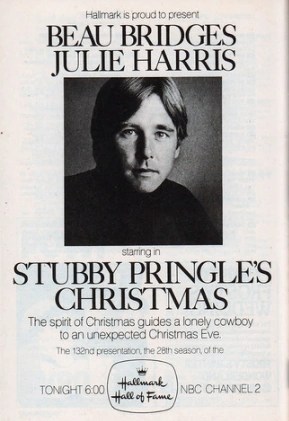
This film aired as a Hallmark Hall of Fame television special in 1978.  It is based on a short story by Jack Schaefer, who wrote the novel Shane (1948), the basis for the 1952 film Shane which many people believe to be one the best Western films ever made.

Stubby Pringle is a young cowboy with unbridled optimism.  We see him in the bunkhouse with two old-timers on the day of Christmas eve.  Stubby has been planning for months to attend the Christmas dance in the community schoolhouse, a twenty-mile ride by horseback.  He has purchased gifts (a box of chocolates and a bolt of dress fabric) for a young woman he met the year before and hopes to see again.

The Christmas eve dance is a celebration of community that Stubby looks forward to for months.  It gives him a chance for romance and the opportunity to eat sweets, dance, and sing, everything a cowboy can’t do stuck on the ranch. 

But on his night-time ride to town he encounters a farm wife chopping wood in a blizzard.  He learns that her husband is very ill, their life has been hard, and they have two small children with nothing to celebrate Christmas. Stubby’s plans change as he offers the gifts of time, labor and emotional support to the farm wife with a broken spirit. 

Stubby Pringle embodies the spirit of Christmas in different ways.  When he asks the farm wife about her tree and presents, she is defensive, she has nothing and replies, “Did you always have a Christmas tree?”  “I never did,” replies Stubby, “that’s how come I know it’s important.”  He believes that children need a Christmas tree with gifts from Santa Claus, in part because he didn’t have Christmas as a child.  Instead of bitterness for his bad turn in life, he embraces the holiday with childlike enthusiasm. 

Stubby shares his positive outlook on life with everyone he encounters, from his bunk mates to the wife of his boss, the lonely farm wife, and even the janitor cleaning up after the dance has concluded.  It reflects the sense of hope that Christmas symbolizes for many, but it transcends December 25 and is Stubby’s philosophy of life; he lives Christmas 365 days a year.  After Stubby describes the hard life of the cowboy and all the “brothers” he knows who have died from pneumonia, cold, heat and even guns, the farm wife observes that he seems to think about death a lot.  Stubby’s response is powerful:  “No ma’am, no, I think mostly about life because I love it.  There ain’t nothing better than waking up and knowing you got a chance at another day.” 

The production embraces the Western genre in many ways, from the 19th century language used by Stubby and others to the casting of character actors with a large body of work in Hollywood Westerns (Strother Martin, Chill Wills).     

Beau Bridges plays Stubby Pringle with a sense of unlimited energy that feels natural for a young cowboy who works hard, cares about others, and hopes for a better life in the future, all of which affirm the ideal of the American Western. 

Ebenezer (1998)

A Christmas Carol has been retold in countless ways with a host of actors taking on the role. An internet search provides many recommendations for the best and/or worst film versions of the classic story.  George C. Scott. Patrick Stewart, and Guy Pearce have appeared in versions committed to historic accuracy while Bill Murray, Jim Carey, Michael Caine, and Henry Winkler appeared in other interpretations of the story.  Even a futuristic sci-fi version written by Rod Serling aired in 1965 (Carol for Another Christmas).

Ebenezer appears to be a classic Hollywood gimmick: set the story of Scrooge in the Old West and portray him as a villain right out of the archetypal Western. “Bah, humbug” is replaced with “hogwash” and Scrooge is decked out in black, including his hat.  But there is something working in this film that sets it apart from other versions of A Christmas Carol.  The story is not simply retold in a dusty 19th century town with cowboys and dance hall girls and gun slingers. The Western genre provides depth to the narrative and in turn enhances the power of the original story.

Scrooge is played by Jack Palance, who achieved prominence as the hired gun in the film version of Shane. Nominated for an Academy Award for this breakout role, Palance made a career by portraying villains.    

Ebenezer Scrooge is a liar, cheat, and thief, who deceived his father-in-law and lost his wife, swindled his dead partner’s daughter out of her inheritance, and cheated at cards to gain a ranch and a horse from a naïve cowboy.  When confronted by his enemies, he turns to physical violence including a willingness to use a gun to get his way. 

Ebenezer was filmed in Canada and the plot explains that Scrooge went from his home in Philadelphia to the West to make his fortune, and after cheating his father-in-law by selling his ranch, he goes to Canada in search of gold.  He owns the local saloon where he spends his days gambling and treating bartender Bob Cratchit as an object of ridicule.

Scrooge isn’t impressed by the visit of Jacob Marlow (Marley) and his warning to change his ways before it is too late.  Scrooge’s response to Marlow is a loud and exaggerated “Blah, blah, blah.”  He makes it clear that he doesn’t fear the prospect of visiting spirits.  To prepare, he cocks his rifle and dares any ghost to “take your best shot.”

The Ghost of Christmas Past addresses a larger issue than Scrooge’s personal history.  Played by a First Nations (Cree) woman, the mere presence of a native figure gives Scrooge pause.  “Are you Pocahontas” he asks.  The spirit replies, “No, but I have met her” and she informs Scrooge of her mission.  “I didn’t know you people celebrated Christmas” he observes.  In an affirmation of the larger meaning of the holiday, the spirit says, “We may not call it Christmas, but we do celebrate friendship and family and love on many levels, but since the arrival of you people the notion of exchanging gifts seems rather appealing.”

The Ghost of Christmas Present uses horseback to transport Scrooge to see the struggles of others in his community and the Ghost of Christmas Future is the faceless, hooded figure that inhabits nearly every version of A Christmas Carol.  Both ghosts perform their duty by showing Scrooge the truth he ignores in the present and the true consequences if he doesn’t make changes in his life.

As expected, Scrooge is transformed by the experience, but the ending again turns the story around to embrace the Western genre.  Instead of simply sharing his good cheer and his wealth, Scrooge is forced to make a life-or-death decision regarding a gun fight of his making.  The film ends not with dinner at nephew Fred’s home but in the community center with everyone in town in attendance.  Scrooge takes on a new role and hopes the stunned community will forgive him for his many sins against humanity, but the crowd is skeptical.  It is only the act of a single child, willing to join Scrooge in a Christmas song, that allows the townspeople to accept and then embrace the transformation of Ebenezer Scrooge.

Christmas and the Cowboy Way

One mark of the lack of appreciation of these films is that they have not been distributed widely. Ebenezer was released as a VHS and later as a DVD but is difficult to locate today.  The film used to play on TNT during the holiday season but seems to have disappeared. However, a version with good quality is available on youtube if you are interested. 

Stubby Pringle’s Christmas has never been released on video and has not been aired in any form that I am aware of since the 1980s.  However devoted fans shared copies for many years.  If you are interested, the film is on youtube and currently available. 

Rhetorical scholar Janice Hocker Rushing studied the Western Myth as constructed in twentieth century films and television and concluded that at its core, the myth centered on the tension between the individual and the community.  This tension is played out in many forms but serves as the primary lens of the Western genre.  Christmas gives two very different characters a chance to share and to receive unconditional love from their own unique community.

Stubby Pringle is an orphan who wants something more than working the range by himself.  He wants a wife, a family, a home, and Christmas gives him a way to express that inner need with others.  While his plans are dramatically changed by his decision to stop and help others, he ends the night with love in his heart.  He has achieved the miracle of Christmas in a small way and can continue to hope for more.

Ebenezer Scrooge is the worst kind of person in any community, he holds power over others through money and possessions and that pursuit has grown from greed to evil incarnate.  He lives in a town but has no presence in the hearts of the people.  It is only when he seeks redemption from the the entire community at the Christmas pageant that he is truly transformed. 

Stubby Pringle epitomizes the Christmas ideal in every way: “to give up one’s very self – to think only of others – how to bring the greatest happiness to others – that is the true meaning of Christmas.” Ebenezer Scrooge has taken the first step toward that ideal if we can trust the words of Charles Dickens, “Scrooge was better than his word. He did it all, and more. . . . He became as good a friend, as good a master, and as good a man as the the good old City knew, or any other good old city or town in the good old world.”

If you get the chance this year, take a chance and watch these two films that truly capture the spirit of Christmas and the cowboy way.

An Analysis of The Card Counter (2021)

Readers Note: This essay contains plot details

By Spencer Short

Introduction

The Card Counter tells the story of a formerly imprisoned solider turned professional gambler named William Tell. He is an enigmatic character, leading a solitary life of travel, gambling, and contemplation. We are introduced to Tell through his narration, beginning and ending in prison. During his eight and a half years of confinement, Tell taught himself to expertly count cards, enabling guaranteed success and control against the house.

Slick, stylish gambling movies are a foundational component of American film culture.  The Card Counter, however, is much different. We do learn tips and tricks about certain games, but the film is more concerned with Tell’s struggle to regain peace of mind and his stolen sense of self. Through Tell’s story, we explore friendship, love, justice, revenge, and responsibility. Finally, we explore forgiveness, the most important theme in the film. Tell is on a journey to save another’s soul, in the wake of unimaginable suffering. Despite the tragic ending, and life lost, a hopeful note remains. William Tell has begun to save himself, as he experiences forgiveness. His forgiveness of self is awakened by forgiveness from another. 

Tell seeks structure, predictability, and anonymity as a way to keep his past at bay. He prefers low-stakes gambling and eschews “celebrity gambling”. He keeps his past completely private, and the person who comes to know him best, La Linda, is still left in the dark for much of the film. She tries to find an opening in his protective shield, and asks if he has been in prison. La Linda is a good poker player, reading Tell immediately. It doesn’t matter to her that he’s been away; she’s just hoping he will share something about his life. “I like to play cards” is really the only thing Tell is willing to share, even as they become increasingly close.

Eventually, we learn that William Tell used to be Private First Class William Tillich. He was trained in interrogation under retired Major John Gordo, who escaped accountability for torture of prisoners during the Iraq War. Tell did not escape, instead sentenced to ten years in military prison for his involvement. Tell’s new life as a professional gambler is upended when he sees Gordo again after several years, leading to an encounter with Cirk Baufort, whose father served with Tell. Cirk’s father and Tell both worked under Gordo in Abu-Ghraib. Cirk blames Gordo for his father’s abusive behavior, alcoholism, and eventual suicide. He hopes to enlist Tell in his quest to punish Gordo. At the same time, Tell begins a professional and personal relationship with La Linda, another professional gambler. In very different ways, each of these characters force Tell to reshape the world he has created for himself.

Purification

The audience quickly gets the sense that Tell is not living a healthy or well-adjusted life. Suffering lurks in the atmosphere, although we do not learn the specifics until later. The film opens with the pure green felt of a casino table – a singular color staged against ominous background music. Purity and purification loom large throughout The Card Counter. Tell’s ritualized purification process – wrapping the contents of his motel room (bed, table, chairs) entirely in white sheets – is performed with the care of religious ceremony. This is a form of sensory deprivation, a technique used in both meditation and torture. Tell may believe that his ritual is meditative, but the audience experiences only alienation. His room becomes ghostlike. It’s unsettling – upon first viewing, we wonder if something more sinister is about to happen. Despite Tell’s efforts, his purified motel room becomes a blank canvas for nightmares of the past.

Archetypes

The four main characters are drawn in an archetypal way – they reflect timeless personal conflicts of humanity. The name William Tell directly references the man who was, according to legend, forced to shoot an apple from his son’s head with bow and arrow as punishment for defiance against government authority. William Tillich likely picked the new name as a direct reference to this legendary character.

Broadly speaking, Tell’s role is that of a martyr, dutifully taking on personal suffering, when others, like Gordo, refuse. Furthermore, in a film with so much poker, it can’t be a coincidence that the main character’s last name is Tell – a poker tell. Tells in poker signal deception, the subject of Gordo’s presentation. Gordo is a personification of wrath and greed left unchecked, taken to their logical extremes. He’s larger than life. He’s “right out of fuckin’ Call of Duty”, as Tell explains to Cirk. 

Gordo’s law enforcement seminar presentation, touting his expertise in security, is a continuous series of hedges. He speaks with a mundane straightforwardness, but upon closer inspection, it’s clear that his software is little better than useless. The developers and Gordo just want an excuse to gain “field experience”. Notably, Tell performs a poker tell as he hears this – rubbing his face. He knows what the rest of the audience doesn’t know (or doesn’t want to admit) – “field experience” is code for torture.

Another main character, La Linda, is archetypal. She is Lady Luck, the muse of gamblers. She even says so directly – “L.L. – like Lucky Lady”. The “La” also indicates a musical quality; her relation to life is playful, unlike Tell. Not only does she provide luck in the form of financial backing for Tell’s big-stakes poker, she becomes Tell’s only real friend. Tell is destined to change upon meeting her.

Throughout the film, Tell tries to include Cirk in his friendship or family with La Linda. Tell longs to mentor Cirk, and help him steer his life right. Tell calls him “the kid” almost exclusively after a certain point in the film, attempting to rewrite his narrative. Everything about Cirk signifies chaotic immaturity. His appearance is unkempt, and he always looks like he just rolled out of bed. His hotel room is a mess. Cirk first shows up at Gordo’s presentation wearing a “Pew Pew Tactical” shirt. Cirk is comfortable openly discussing murder, but for all intents and purposes, he is still just a child playing pretend with finger guns and “pew pew” sound effects.

Clothing is highly symbolic for each character. Tell’s wardrobe consists entirely of muted grays and blacks. This is in stark contrast to every other character in the film – Mr. USA, an obnoxious poker player on the circuit (flashy and exploitative red, white, and blue), La Linda (varied outfits of self-expression), and Cirk (unkempt and juvenile).

Noise and Circles

Tell’s first word to describe his experience in Abu-Ghraib is “noise”. Noise is a recurring theme in The Card Counter – noise that tortures, and noise that heals. Tell thrives in casinos, inherently chaotic environments, but he is careful to never spend the night in a casino hotel, always choosing simple motels miles away instead. As Tell’s arc progresses, he learns to see beauty in noise and chaos. More accurately, he learns that some noise can be beautiful. La Linda takes him to a visit a park “all lit up at night”. She is dressed in white – mirroring Tell’s omnipresent white sheets. Visiting this park with La Linda is a healthy version of the purification ritual.

Tell says that red-black in roulette is “the only smart casino bet”. Spirals and circles figure prominently in the film. Cirk is caught in a downward spiral. His full title – “Cirk with a C” – implies the word “circle” itself. In one of his many efforts to mentor, Tell explains to Cirk that he’s gone “round and round” until he “figured it out”. This is something that Cirk refuses to do – he lets the circle control him, instead of the other way around. In another powerful sequence, Tell’s nightmare scene of suffering prisoners is horrifyingly realistic. The only clue that this is not real is the infinitely warping floor – another set of spirals.

Gambling and Interrogation

Early on in the film, we are introduced to a recurring motif of abstract sound design – it is partly ambiguous, though the sounds seem to depict breathing and desire. It’s an ever-present low level of tension and noise, the aural remnants of Tell’s past. Tell ponders this moral weight in his journal, stating that it can never be removed.

Tell’s concept of “force drift”, something he explains to Cirk, is echoed throughout the film in various forms. Force drift is experienced by interrogators as their increasing efforts to obtain information through torture draw decreasing results. The frustration and power become intoxicating – causing the interrogator to “tilt”. Tell believes he has convinced Cirk to abandon his effort to kidnap and torture Gordo and instead return to college and reestablish a relationship with his estranged mother. When Cirk sends Tell a picture of Gordo’s house, Tell knows that Cirk has lied to him. Tell looks directly at the camera/audience, as if to emphasize that any one of us can tilt, calling to mind a previous scene where he told Cirk exactly that.

In The Card Counter, the present is always subservient to the past, but that connection only becomes clear in the second half of the film.  It is the “weight that can never be removed”. The parallel story of war atrocities and its legacy for America is told in tandem with the story of professional gambling and its normalization as just another form of entertainment.  Casinos are everywhere today and the World Series of Poker is mainstream televised competition, seen on cable television networks devoted to sports.  In the same way that Tell seeks peace through distraction, Americans follow the same path by spending so much time, energy and wealth in the many ubiquitous forms of gambling available. 

Responsibility

Tell tries to convince Cirk to do the right thing. Unfortunately, he uses the wrong methods – methods partly inspired by Gordo’s interrogation training. Tell does not harm Cirk, but we are absolutely convinced that he might. Despite good intentions, and $150,000 in cash, Tell’s help is ultimately reduced to a conditional threat – “I’ll find you”. Tell punctuates the mock interrogation with, “I did this for you”, an obvious contradiction. Tell really does care about Cirk – even when Tell finally connects intimately with La Linda, he prefaces it by mentioning Cirk. The love that Tell has for Cirk doesn’t seem to be enough, though.

Upon first viewing, it seems as if Tell really is going to torture Cirk – he has the right tools, after all, and he seems prepared to act. Tell’s sinister duffel bag – containing gloves, and what appear to be bladed weapons, is omnipresent, since the first motel we see him visit, but there is little attention drawn to this fact. The audience only gets a quick shot of the contents, but that is all that is needed to convey threat. Tell dutifully caries both bags, one in each arm, like the scales of justice. He never lets go of his baggage – he never forgets what happened.

The film does not seem to communicate that Cirk’s fate is inevitable. Everything about the story instead emphasizes Cirk’s potential to make choices and steer his own fate. Cirk just doesn’t have the same perspective as Tell. Cirk is in pain, but he doesn’t realize just how painful life can be – living a life like Tell’s life. Tell tries to warn him, but Cirk cannot listen.

Cirk’s attempt to catch Gordo leads to Cirk’s death. Upon learning the news, Tell tilts a second time, immediately leaving his motel to drive nonstop overnight to Gordo’s home and confront him. Tell lies in wait for Gordo, after purifying the house with white sheets.

“We are each responsible for our own actions”, Gordo states conclusively. Tell agrees, but the difference is clear. Tell had no choice but to take responsibility. Tell served his time.  Gordo never took responsibility – he took every opportunity to advance his career instead. He doesn’t even seem to care about Tell much. Gordo casually dismisses news of Tell’s eight and a half years in prison – “that’s a bitch”. Tell and Gordo step into another room, where unseen torture takes place. Tell calls it a “dramatic reenactment”. After Gordo’s death, Tell continues to take responsibility by reporting the killing to police.

Responsibility is different from justification. Tell says “nothing justified what we did” – something that both Tell and Cirk’s father understood. Something Cirk could have understood, if he was there. Cirk is obsessed with justification – he feels fully justified in his plans to torture and kill Gordo. This is justice, according to Cirk – an eye for an eye. Tell understands that justification doesn’t matter – responsibility does. Tell has figured out a way to manage his relationship with his past, unlike Cirk. Cirk doesn’t respect himself enough to put effort into anything constructive. As Cirk darkly notes, he only has one interest.

Providence and Grace

Tell is an excellent, professional gambler, who can see into other people’s souls. That’s what a good player can do. This skill applies outside of gambling as well, though. Tell sees into Gordo’s soul. He sees Cirk, he sees La Linda. He even sees himself, to some extent. But there is still a missing piece.

In many Paul Schrader films, religion plays an important role. In The Card Counter, Tell does not explicitly identify as a religious person, but one scene in particular is definitely focused on religious imagery. We see Tell, writing in his journal, shirtless. On his back is a prominent tattoo: “I trust my life to Providence. I trust my soul to Grace”. This seems out of place for a professional gambler, who lives by games of chance, but the contrast is powerful when one considers the theological definitions. “Providence” suggests that everything happens for a reason; our lives are part of a larger plan, set in motion by an omnipotent deity. In contrast, “grace” stresses that each person ultimately receives salvation, regardless of their good or bad deeds. This is something dormant in Tell, something that La Linda can realize and activate by forgiving and accepting him.

By trusting his life to providence, Tell understands that forces beyond his control, whether God, government, or fate, have dictated his path. He accepts predestination, which in turn allows him to achieve a degree of balance. In regard to his soul, Tell believes that grace offered by God will provide redemptive salvation regardless of the sins he has committed.  Although he never expresses any sense of spiritual hunger, the idea that he trusts his soul to grace suggests that he can see something beyond the routine of daily life, a final outcome that will offer peace for a life that has been defined by torture. 

Conclusion

When La Linda visits Tell in prison, in the film’s final scene, it calls to mind Tell’s philosophy of forgiveness: forgiving oneself and being forgiven by another should be indivisible. There is a solid glass barrier between them, but the human connection from their fingertips breaks past.The film begins and ends in prison. Something presented first as a continuum – nothing changes. Then “something happens”. Tell reflects back on his first diary entry and first line of the film – “I never imagined myself as someone suited to incarceration”, when he is interrupted by La Linda’s visit. Tell is back in prison, but a fundamental shift has occurred. La Linda has forgiven him, allowing him to forgive himself.

The Card Counter is not a comfortable film to watch, but one that deserves attention. Its deepest lesson lies in its exploration of forgiveness. The Card Counter is worth watching more than once and like all forms of great art its impact will linger long after the first viewing.