Ghost Stories (2017) Film Analysis: Human Hauntings

By Spencer Short

Written and directed by Jeremy Dyson and Andy Nyman, based on their stage play

Readers Note: This essay contains plot details

Ghost Stories is a rich, layered character study and ethical examination of professor and professional paranormal debunker Philip Goodman. In the film, he examines three impossible-to-explain supernatural case studies, three “ghost stories” that are far more than they first appear. The film opens with an ambiguous collection of symbols – the sounds of dripping water, then labored breathing. After the title, we see random chalk numbers, then an upside-down window, as Philip Goodman narrates, “it was my father’s religious beliefs that destroyed our family.” Wings flutter, and we are at Philip Goodman’s bar mitzvah, an event featuring smiling family members, but depicted with an atmosphere of melancholic detachment. The bar mitzvah is the first clue that this film is concerned with studying transitional life stages, something beyond simple stories designed to scare the audience.

In a few brief segments of home movies after the bar mitzvah scene, we see what Philip is referencing. His father violently disapproves of Philip’s sister’s relationship with a man of another race and religion. In a quick series of cuts, we see young Goodman filming his father, who sees Philip and becomes angry. His father’s suspenders are undone, implying that they have been used for punishment. A young, smiling Goodman dissolves to an older, weary Goodman, who warns, “we have to be so very careful what we believe in.”

Goodman hosts a television show that aims to debunk paranormal phenomena and expose manipulative false psychics. The blunt title of his show, Psychic Cheats, is simple reality TV branding, aimed at a broad audience. From the brief segments of the show that we do see, it is not necessarily a profound intellectual voyage, as Goodman imagines. The primary goal is to expose, and humiliate, false psychics and other manipulators. Indeed, these false psychics are taking advantage of people, and exploiting tragedy; but Goodman doesn’t seem to be involved in a sober search for truth, instead he plays up the base appeal. It is a simple reality show, after all – audiences tune in for the drama and conflict.

Charles Cameron

Shortly after we meet Goodman, we see that he is planning to meet with a man named Charles Cameron. Decades prior, Cameron did the sort of paranormal debunking work that Goodman models his TV show and, by extension, his life’s work on. Philip Goodman sees Charles Cameron as his mentor, even though the two have never met before. Goodman speaks about Cameron’s inspiration, ironically, in religious terminology. He says that watching Cameron was like being hit by a bolt of lightning, and he realized that’s what and who he wanted to be – a professional debunker of the supernatural, using psychological and scientific explanations to counter paranormal experiences.

Shortly after they meet, Cameron immediately rebukes Goodman, and says that he looks back on his past with shame. Cameron does not mince words in response to Goodman’s work, “it’s shit”; he has learned from his past and moved on, while Philip Goodman has entrenched himself further into his arrogance.

Cameron also mocks Goodman’s marital status, he’s “not surprised” that Goodman isn’t married. This isn’t a jab at his courtship skills or lack thereof, but rather a comment on Goodman’s philosophical worldview. His character epitomizes the most extreme form of philosophical materialism and as such, long-term relationships and marriage represent a mysterious risk that transcends matter, something too dangerous to engage in.

Cameron gives Goodman three supernatural case studies – experiences that he can’t explain away – hoping that Goodman can make sense of them. Still, Cameron has changed his beliefs based on these case studies, and warns Goodman that “it’s all real.” Cameron’s dire warnings to Goodman are delivered with a firm, maxim-like quality. Goodman doesn’t give these warnings the slightest bit of attention, he is immediately dismissive.

Tony Matthews

Goodman’s first inexplicable case is Tony Matthews, a former night watchman who lost his wife to cancer 23 years prior. Goodman “looks like a teacher”, according to Matthews; Goodman corrects him, “professor.” Matthews says he’s seen the show – “it’s shit” (same line as Cameron) – only a joke, but then elaborates that he hasn’t actually seen it. Matthews slyly mentions that professor is the official title for the puppeteer in a Punch and Judy, a traditional English slapstick puppet show. “The professor just learned something from the humble night watchmen.” Is Psychic Cheats a puppet show? Goodman exposes manipulators, but he manipulates participants for his own ego, as Ghost Stories eventually shows. Certainly, few would defend false psychics, but Goodman’s overall approach and style is worth noting – he doesn’t shy away from the sensationalism of what he does.

Matthews doesn’t want to talk about his supernatural experience, but the two agree on payment. Matthews remains standoffish, especially when Goodman asks if he has any children. Goodman increases the payment, and Matthews proceeds. He notes that his 30-year old daughter has been hospitalized for five years, with locked-in syndrome (a form of full-body paralysis), and then recalls his experience.

The building Matthews guarded used to be “a nuthouse for women” hundreds of years prior. As Matthews listens to a radio show, the power shuts down, right in the middle of callers discussing the meaning of married life, specifically finding simple satisfaction in food and television. After restoring the power, Matthews returns to hear a woman describing her dedication to her bedridden husband who suffered a stroke. Matthews mocks her as he listens, “Well like that makes you a saint, you silly old bitch.” Again, the power shuts down.

Matthew’s Russian work partner says they have a word for this atmosphere back home, zloslivy. Interestingly, złośliwy (which is used in Ghost Stories, the stage play) is a Polish word akin to “malicious”, and guz złośliwy refers to a tumor. This establishes a connection between Matthew’s wife and the building he guards.        

After Matthews restores power to the building, it is cut off yet again. He has seen some disturbing things – a dead bird upon entering a basement area, a figure in the distance, and far-off objects that appear to be a person. Eventually he enters a room with mannequins lining the walls. A girl holding a dead bird hugs Matthews and pries at his mouth with a finger. We cut to the present, see an upside-down window, then Goodman talking to Matthews’ priest – Matthews’ experience brought him back to the church. Goodman asks what the priest’s responsibility is when a “grown man” wants to discuss a supernatural experience. The priest says that these experiences are signs encouraging belief.

Goodman is dismissive of the priest, and keeps trying to lead to a further point. He tries to get the priest to assume for the sake of argument that what happened was real. The priest says Matthews “testifies that he saw a spirit, and he changed his ways accordingly…in what way is that not real?” Goodman wants to lead to the point that Matthews had hallucinations caused by grief. The priest responds, “I’m so tired of this modern disregard for the spiritual life. How unfashionable it’s become to believe in anything other than our own personal gains.” Is this all that Goodman believes in? Is this what his Psychic Cheats show is really about? Goodman does fashion himself a minor celebrity; he hopes that Matthews has recognized him from TV when the two first meet.

Matthews went to see his daughter the day after his experience, and when she heard his voice, the doctors say her heart skipped a beat. The priest uses this to counter Goodman’s claims that there is no physical evidence to corroborate Matthews’ experience. The connection between Matthews and his daughter transcends physical reality, as shown by her heart’s response.

Matthews’ priest tells Goodman he should consider this phenomenon in relation to his own family. Goodman actually takes this advice and visits his father, who is suffering from a similar illness as Matthews’ daughter. His body is not totally paralyzed – one shot lingers on small finger movements and his wedding ring, but Goodman’s father cannot speak or react to Goodman, and it is unclear if he understands that he is there.

Matthews has a habit of calling other people “sunbeam”, which has multiple potential meanings. “A single sunbeam is enough to drive away many shadows.” – St. Francis of Assisi. It may indicate Matthews’ connection to humanity – people as beams of light, connecting at the speed of light, or it may be a down-to-earth, but partially dismissive way of addressing others. After all, he does call Goodman and his co-worker Sunbeam, similar to addressing other people as sunshine, which can vary in tone and implication.

Simon Rifkind

Goodman’s second case study involves Simon Rifkind, a troubled young man who is immediately suspicious of Goodman. When Goodman arrives, Rifkind keeps the bright red door chained upon opening, “you might not be the man that I spoke to” – a strange opportunity to impersonate someone for malicious ends, but Rifkind requires physical proof – the letter he sent to Cameron. Rifkind’s parents are in the kitchen, motionless and staring directly at a wall. The door slams shut right before Goodman goes upstairs to reconvene with Rifkind.

Rifkind is obsessed with studying demonic and occult imagery as a way to understand what happened to him. He wants to keep these images out so he can see them all the time; his walls are completely covered. If he doesn’t want to see them, he “can look over there” – at a single image of a plush toy bear pulling the ear of a frowning plush toy dog, comically out of place in the midst of his accumulated demonic imagery. Rifkind’s obsession points toward two types of demons – personal demons, and demons as creatures – physical forms of fully realized evil.

Rifkind’s manic energy and defensiveness seem to indicate that he has “stared into the abyss” for too long. He has been driven to the edge by surrounding himself with and absorbing massive amounts of dark information and imagery. He finds these things in books, and “on the internet”, an acknowledgment of the role of technology in pressing us with more information than we can possibly handle, creating dark obsessions for many.

Rifkind’s story begins with driving his father’s car after failing his driver’s license test. In a heated phone conversation with his father, it’s revealed that Rifkind also failed to send in a housing form for college. Suddenly, a creature drops right out of the sky and on top of Rifkind’s car. Rifkind examines the creature, dead, behind his car. We see horns and a goat-like head, then the full body. It is a demon.

Rifkind drives away, but his car eventually stops. He manages to find enough cell phone service to call for roadside assistance, but the demon appears again, entering his car. It sits behind Rifkind, places its hand on his shoulders, and tells him to stay. Rifkind flees, then comes up against a tree-like creature, who growls and grabs his head.

After hearing this story, Goodman arrives in the woods at the scene of Rifkind’s experience. As he stares at a pile of earth and roots at the bottom of a fallen tree (possibly the same tree that attacked Rifkind), he narrates into his recorder, still not convinced, “It feels quite simple to me, really. The brain sees what it wants to see. They’re your words, Charles [Cameron]. Tony Matthews is an alcoholic who’s wrestling with unresolved grief. And Simon is a fragile young man and from a deeply dysfunctional family who’s on the edge of psychosis.”

Mike Priddle

In his third case study, Goodman meets Mike Priddle – on a long pathway, outdoors in a field. Priddle is a confident, boisterous businessman. We learn that Priddle wanted to have a child, but his wife sought more financial security through partnership at her law firm first. Priddle is presented as a down-to-earth, practical person, in contrast to Goodman. “Someone’s got to earn the money so you brainy poofters can sit around stroking your chins and pulling onion out of your arses all day long.” Like with Tony Matthews, Goodman is pressing and rushing Priddle to get to the incident. Goodman doesn’t like to chat, he wants to quickly hear each person’s story so he can start poking holes.

As Priddle looks for the key to his gun safe – located far away from any other building, he continues on with the story. When Priddle’s wife got her partnership, they began trying for a child, but ran into complications. “A splash of IVF get the old baby machine working again…30 grand later, bull’s eye”, but Priddle’s wife ran into further complications seven months into the pregnancy.

As Priddle continues his story, we first see him at his lavish house, in winter. He has heard a few eerie noises and disturbances during the night. After walking through his house, he settles in the room set up for his new child. As he reaches for the empty baby crib (Maria is still in the hospital), something bursts on the other side of the room, sending diapers flying from the changing table. As Priddle picks up, multiple items at the table spontaneously assemble and stack on top of each other. Priddle sees this as a poltergeist – “an evil spirit or an angry spirit”. Goodman is unconvinced, “there’s absolutely no evidence to support that”, he states with a small chuckle.

 The doctors scanned Priddle’s wife Maria, but didn’t want to show them, as there were “distortions on the screen or something.” The film shifts back to Goodman, who sees a figure in the distance at a higher point of the road, then it suddenly appears and disappears in front of him. As Priddle continues the story, the figure follows them from a distance.

Priddle sees the mobile moving itself at the crib. A sheet rises from the crib, the temperature drops, and flowers wilt. Priddle sees his wife, who flatly tells him “we are dead.” When the hospital called, “I knew what they were going to tell me. The Prophet.” Maria died in childbirth, and Priddle says he’s glad she didn’t live to see what baby Barty looked like. After finishing his story, and telling Goodman that life finds a way and goes on, Priddle kills himself with his shotgun.

Like Tony Matthews, who “went back to the church”, Priddle “[didn’t believe in evil] until that night.” Both of these statements are moral proclamations that clash with Goodman’s materialism. Priddle’s work nickname, “The Prophet”, is another religious reference that prods at Goodman’s worldview.

Desmond Callahan

After witnessing Priddle’s suicide, Goodman drives back to see Cameron and confronts him, claiming that all of these cases are part of a hoax. Cameron tells Goodman that he lacks the humility to try to understand that things may not be as they seem. Goodman says, “Everything, everything is exactly as it seems.” The structure of Goodman’s experience begins to collapse in upon itself, as Charles Cameron pulls his face away – a mask – revealing Mike Priddle beneath. Priddle uses his finger to cut through the window, just paper, revealing a black wall and door.

Charles Cameron / Mike Priddle speaks for Goodman’s subconscious – his guilt, his insecurities, and for what he knows to be true despite all his efforts to suppress it. Priddle now addresses Goodman directly, using the voice of a school bully, hurling antisemitic taunts, as the two walk near deserted train tracks.

Goodman and Priddle reach a tunnel. Priddle disappears, leaving Goodman with his bullies, who continue the antisemitic slurs and references as they demand Goodman to approach. Now, we see a young, school age Goodman, letting the audience know that this is a key memory. We are finally directly in Goodman’s mind, after spending the majority of the film with Cameron’s three case studies.

The bullies demand Goodman line up against a wall as they throw rocks at beer bottles, one by his foot, then one by his face. Before they can throw the second rock, another person approaches, derogatorily called “Kojak” by the bullies (and Goodman as well, but not to his face). This is Desmond Callahan – he is mentally disabled and does not understand the harmful intentions of the two other boys. They push him to enter a tunnel and count the numbers inside. If he remembers the tenth number, he can join their gang; but there is no tenth number. One of the bullies threatens Goodman with a broken beer bottle by his neck, so he’ll keep quiet and not try to help Callahan.

Callahan suffers an asthma attack inside the tunnel, in a scene that is stark and disturbing to witness. The bullies flee, and Goodman flees as well; after a short pause moving to the present, adult Goodman sees Priddle again, who confronts him, “You left him to die in there, didn’t you?” Goodman asks, “What could I have done?” Priddle answers quickly, “Told someone when you got home? Brought it up in assembly the next day? How about running into The Echo to see if Desmond needed help?” Goodman says it was a fluke. Priddle rejects that answer, “The only fluke here is the fluke in his DNA that left him vulnerable to people like you.”

Goodman is highly offended by Priddle’s “people like you” comment. Goodman says, “I’ve spent my life trying to help people…trying to help people see the truth in amongst the sea of sentimental lies and crap.” Goodman says he isn’t responsible because he didn’t force Callahan to stay in the tunnel. Priddle says, “That’s right, you did nothing.” Goodman ascribes immorality primarily to beliefs, not actions, so it makes sense that he does not place importance on inaction. To be fair, one of the bullies threatened Goodman with a broken beer bottle to the neck if he didn’t let Callahan in the tunnel, but at no point did Goodman attempt to help, even after both of the bullies fled the scene. It is clear that the film wants us to side with Priddle, and condemn Goodman’s inaction. In the stage play, Goodman’s excuses are described as “pathetic.” After the bullies left, nothing was stopping him from entering the tunnel and contacting Callahan’s parents.

Priddle says that Goodman has spent his life “reducing life’s biggest questions to atoms and molecules.” This is philosophical materialism, the belief that matter is all that exists. “What else is there, for God’s sake?” Goodman asks, ironically invoking more religious language.

Priddle spells it out for Goodman in no uncertain terms, “…what you’ve actually been doing with your life isn’t helping others, it’s running from your greatest fear, which is that there’s more than the here and now, and that every action you’ve ever taken, or didn’t take, has had an effect. It’s left a little trace. A ghost of itself.” This is, of course, the thesis of Ghost Stories. Every character has urged Goodman to look beyond, but Cameron as Priddle is the one who finally forces Goodman to see this using the only thing Goodman can understand – his own experiences.

The Hospital

After the confrontation, Priddle leaves with his son Barty; Callahan reappears, rotting and with green skin. He pulls away Goodman’s clothes to reveal a hospital gown and, like Priddle, pulls back further scenery to reveal a hospital bed behind a curtain in a white brick hallway. As Goodman lies in the hospital bed, Callahan lies next to him, forever.

Now in the hospital, two doctors go over Goodman’s state – he has attempted suicide via self-asphyxiation in his car. He is “here for keeps”, a “probable lock-in.” In a twisted Wizard of Oz moment, it is revealed that Goodman’s three case study subjects are actually hospital employees caring for him. Priddle and Rifkind are doctors, and Matthews is a custodian. Beyond the Wizard of Oz reveal, even shades of A Christmas Carol can be read in Ghost Stories, with three people (or ghosts) urging Goodman to change, but it’s been too late the entire time. What would Philip Goodman say about his own medical state, if he had the chance? Would he place any value on the life and experience of someone in a locked-in state, or would he reduce that person to “atoms and molecules?”

Dr. Priddle, who wore the face of Cameron in Goodman’s mind, references Cameron as his old professor, who used to say, “let’s just hope his dreams are as sweet.” A radio interview can be heard when custodian Matthews enters to clean up, echoing the radio interviews heard by night watchman Matthews, “love has a way of conquering…” and “it sounds silly, but we like doing everything together, whatever it is.” Goodman doesn’t seem to have any friends or family left to give him consideration, and his medical condition is just another part of the job to the hospital employees; Dr. Priddle especially, who jokes that Goodman should’ve used a shotgun if he really wanted to die. Custodian Matthews tells “sunbeam” Goodman to “be good”, and moves a mirror so he can see the window, for a “change of scenery.” We see the inverted window from the beginning of the film, and a bird suddenly thuds into it. Then, in a noticeable tonal shift, the popular 1960s song “Monster Mash” plays.

Goodman’s reality has been trying to break through continuously – in his mind, there have been scenes of Callahan and the bullies, shots of hospital scrubs, the upside-down window; Goodman even sees himself at some points, but now, it is fully revealed. In the stage play, Goodman’s case studies are part of an academic lecture, which he restarts after the hospital reveal. He is locked in an infinite loop, forever.

The Last Key

Earlier in the film, searching for the key to his gun safe, Priddle asked Goodman, “why is it always the last key unlocks everything?” The last key is the central ethical reveal of the film – young Philip’s decision to abandon Desmond Callahan in the tunnel – which invites comparisons to coming-of-age stories that deal with life-changing events in adolescence. Ghost Stories walks a dark path that is not usually explored in traditional coming-of-age storytelling. In most coming-of-age dramas dealing with adult themes, the characters ultimately find some way to grow and move on from their experiences. But what if the characters didn’t move on, and instead permanently corrupted themselves? What if they didn’t simply encounter and deal with death, but were in some way responsible for it? This is the dark branching path of Philip Goodman in Ghost Stories. What makes everything worse is that he has never attempted to process the guilt of his part in the events. It seems safe to assume that Goodman’s suicide attempt is connected to that day, and that he hasn’t thought about Callahan in years, maybe even decades. Of course, Goodman is a victim of abuse as well. It is important to remember that when Priddle confronts Goodman about his responsibility, this is Goodman speaking to himself. Goodman knows that he did something wrong, but he has avoided confronting what happened in any capacity. He hasn’t tried to learn a lesson and change, like the three subjects of his case studies.

The events of the fateful day in Goodman’s memory are the roots of his identity, a fallen tree with no foundation, just like the tree in the woods of Rifkind’s encounter. This monstrous tree creature struck at Rifkind’s head, his mind, just like Goodman’s belief-hating belief system struck at his. The very first line of the film is about beliefs – Goodman says his father’s religious beliefs destroyed the family, implying that the beliefs were more instrumental than the violent actions themselves. As Priddle spelled out, Goodman’s worldview is just a way to avoid dealing with the day he abandoned Callahan. One of the film’s major lines, “the brain sees what it wants to see”, has a double meaning. Cameron used to use it as a way to dismiss people’s experiences, which Goodman adopted, but it also refers to the human capacity for self-deception. The excuses Goodman gives to Priddle are “psychic cheats” against himself. Goodman’s three case studies have all accepted moral lessons from their experiences, or at least accepted that these experiences forever changed them, unlike Goodman.

 Everything that happens after the introduction of Goodman’s character seems to be in his head – it is noted that Cameron mysteriously disappeared, abandoning his car near his home. After this, we see the second upside-down window shot after a fluttering of wings, indicating that Goodman is in the hospital. This is when Goodman receives a personal invitation from Cameron in the mail. Goodman thinks so highly of himself that a disappeared man he has never even met would send him a personal invitation. Goodman’s inflated ego is emphasized in small ways throughout the film – he pushes for acknowledgment and recognition, he pushes his interviews forward, only interested in getting to the debunking stage as quickly as possible, and he is always dismissive of his subjects.

Before the invitation, Goodman says he wishes he could have met Cameron, so that is what his mind begins to do. Again, “the brain sees…” Right before Goodman’s first case, he sits at a bench and sees the two bullies from his memory playing with a dead bird. Another figure, who seems to be young Goodman, stands motionless, facing away from the camera, just like Rifkind’s parents. This is confirmation that Goodman never really received an invitation from Cameron, because Goodman experiences these scenes as if they are unfolding before him, but we know they are actually his memories trying to break through. Furthermore, a Fine Fare grocery store bag lands at Goodman’s feet as he sits on the bench, the same bag from his memory. Fine Fare was consolidated in the late 1980s, so this is a clue that two different time periods are merging in Goodman’s mind.

Goodman attempted suicide at an ambiguous narrative point – the only “real” events of the film are his introduction as a TV personality and his hospital stay. We know that he attempted suicide in April, but there is no context for this in the rest of the film. During the introduction, there are no signs of reality breaking, besides the introductory water drip, fluttering wings, and upside-down window. Goodman’s interview and first clip of Psychic Cheats are presented in a documentary style, so we can take them at face value, although it’s certainly possible that he never had a TV show to begin with. After the introduction, Goodman’s reality is periodically interrupted by memories of the bullies, Callahan, and his younger self, indicating that this is when he’s in the hospital. Similarly, in the stage play, a seemingly lucid Goodman momentarily loses consciousness a few times during his lecture.

Where did the stories of Goodman’s three case studies come from? Are they actually parts of Goodman’s life? The film does not explicitly indicate, but there are some connections to be made. We know that details from the hospital employee’s conversations found their way into Goodman’s visions – the radio interviews, the shotgun, “sunbeam”, Rifkind’s phone conversation with his mother, Priddle checking his texts, and so on, but what about the full storylines?

Rifkind’s tumultuous relationship with his disappointed father mirrors Goodman’s relationship with his father. At multiple points, it is emphasized that Goodman is unmarried and has no children. Perhaps Goodman has suffered the death of a spouse and/or child, and prefers not to talk about it (as he probes for personal details in his three case studies). Indeed, all three men are reluctant to describe what happened to them – Matthews is direct and abrasive, Rifkind suspicious and paranoid, and Priddle goes off on brief conversational tangents. Matthews’ wife died of cancer, and his daughter is in the hospital with locked-in syndrome, just like Goodman. Priddle’s wife died in childbirth, and his son struggles to survive on the edge of life and death. Paralysis ties together Goodman, his father, Rifkind’s parents, and Matthews’ daughter. Though this is Goodman’s own diagnosis influencing the stories in his mind, it has an important deeper meaning – he has spent his life mocking the possibility that there is anything beyond physical reality, and now his agency in that very physical reality is limited to the utmost extreme. Even if he manages to recover and leave his mental loop, he will only be able to communicate using eye movements.

Cultural and class differences separate Goodman and his cases, but this doesn’t necessarily mean a lack of connection. Matthews’ working class and Priddle’s wealthy class identities may represent aspects of how Goodman wishes he could see himself, just like how Cameron is Goodman’s model of a morally righteous person. In between Matthews and Priddle is Rifkind, the most directly similar to Goodman, but with an inversion. Rifkind is obsessed with the occult and demonic, the dark and evil side of the supernatural, whereas Goodman is obsessed with purging his world of anything even remotely supernatural, whether positive or negative. Rifkind’s temperament is more disconnected and manic than Goodman, but the two share a sense of obsession, anxiety, and strained parental relationships.

It does seem that Charles Cameron is a real person, and his identity as a former professional paranormal debunker can be taken at face value. After all, Priddle references him in the “true” reality of the hospital.

Symbolism

The sounds of dripping water occur both at the beginning and end of the film. Priddle fixes a dripping faucet in his story, and Goodman is connected to an IV drip at the hospital. Dripping water is a minor annoyance, but one that represents insistence. It usually continues indefinitely until it is dealt with. It is also an emotionally ambiguous sound, but one that can become ominous with context. Finally, dripping water is of course a reminder of what happened to Callahan that day. It is one incessant reminder among many that symbolizes Philip’s inaction with the memory of the lonely, empty tunnel where Callahan died.

Dead birds are also featured prominently throughout the film. A dead bird is one step down from a living bird with broken wings; it cannot return to experience, but a bird with broken wings still has experience and life, however faint. Dead birds connotate lost potential, something which ties together Goodman and Callahan. The bullies also lost potential through their treatment of Callahan, something Goodman is complicit in.

Interpreting Philip Goodman’s last name in a literal sense may seem inappropriate in a search for symbolism, but the film’s ethical concerns certainly invite it. Custodian Matthews also tells Goodman to “be good”, a major hint about the name. Philip Goodman believes that his work is a moral good – objectively so. Above all, Goodman believes that he is doing his part to fight a moral crusade, perhaps the moral crusade of our time.

Goodman’s three cases all contain religious references – Matthew, Simon, and Michael. Goodman was raised under Judaism, and these names have (mostly) New Testament connotations, but it is worth noting. Mike Priddle refers to himself as “The Prophet” twice. Goodman looks down on religious beliefs, even though he can’t help but utilize religious language and references to express himself. He was inspired by Cameron like a bolt of lightning (the proverbial “strike me down”), and he asks of Priddle, “what else is there, for God’s sake?” Goodman even hears the disembodied voice of Cameron in the forest site of Rifkind’s incident, echoing Matthews’ priest – supernatural experiences are signs. 

A major line in the film, and Cameron’s old catchphrase, “the brain sees what it wants to see”, ties into the credits song. These three cases are ultimately constructed in Goodman’s mind. Goodman’s conscience is trying to teach him something, but of course his personality still influences the style of these lessons. He sees some of the people involved as creatures (or corpses/“zombies”). Mike Priddle’s wife and son are depicted as creatures, as well as the girl that Tony Matthews’ has seen, a stand-in for his daughter. Simon Rifkind meets a demonic creature, and ultimately, Goodman sees Callahan as a creature, which is the most revealing part. Goodman’s worldview is portrayed as arrogance at best, and a total denial of humanity at worst, so the depiction of these characters as creatures is a natural extension of this.

Conclusion

The three case studies tasked to Goodman initially present themselves as traditional scary stories, hence the film’s title, but they are really meditations on life and tragedy; they are allegories about the permanence of human connections beyond physical reality. A ghost is a non-living being who haunts. To be haunted is to be reminded. The last thing Goodman wants is a reminder of his inaction. In the wake of his suicide attempt, this is exactly what he has received.

Do ghosts “really exist”? In Ghost Stories, a simple yes or no is beside the point. Though Cameron says “all of it” is real, and Goodman is urged to believe what people say in a literal sense, this is more about mutual respect and acknowledging possibilities than anything else. Like Priddle says, ghosts are traces of action and inaction, and as Matthews’ priest asked Goodman, what could be more real than changing one’s ways after a powerful experience? People don’t need supernatural experiences to know that there’s something beyond the physical world, because our daily lives continually involve human connection. Goodman’s all-or-nothing approach removes humanity from the equation.

Broken (2017)

Readers Note: This essay contains plot details

By Brant Short

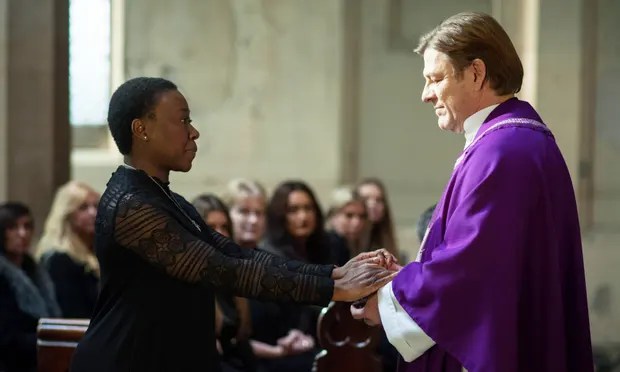
Broken is a six-episode series that aired on BBC in 2017.  It tells the story of Father Michael Kerrigan, a Catholic priest in an urban parish set in the north of England. The industrial city, near the ocean, is not revealed but it is clear that it has suffered economic hardship and all the problems that face any big-city neighborhood.  Typically associated with action heroes in film, Sean Bean plays Father Kerrigan with an emotional range that can be subtle and hesitant, but with an abiding faith that never becomes zealotry and blind allegiance.  He brings humanity to a character who sometimes seems distant and troubled, yet is able to call forth our own empathy for both the priest and the lost souls he counsels. 

Broken does what television does best, it tells a compelling story with enough time for depth and breadth of character development and narrative complexity.  Like a powerful novel, the film uses the life of Father Kerrigan and several members of his community to reveal existential crises people face on a daily basis.  Each episode focuses on a central character’s struggles, but it does not become a series of individual self-contained stories.  The episodes function as chapters that reveal connections among the characters and Father Kerrigan’s efforts to help.

The people who come to Father Kerrigan suffer from the kind of problems not solved with advice or prayer.  They are pushed to the edge, mentally, economically, and socially.  Addiction, mental illness, discrimination, poverty, and other social ills threaten his working-class community. Some are faithful members of his congregation and others not connected to the church who seek spiritual help.

In the first episode, a single mother, working in a dead-end job, struggles to provide for her three children.  When a crisis occurs, the mother makes an ethical decision that has legal consequences, a decision grounded in trying to find enough money to pay the rent and buy food for her family.  Subsequent episodes center on different members of the community who are experiencing life crises.  A police officer is confronted with telling the truth or being ostracized by his entire unit when an arrest ends in a death. A mother seeks help for her adult son who is experiencing mental illness.  A gay man is threatened by violent neighbors which they justify by Christian fundamentalism.  A woman who committed a crime shares her plan to commit suicide and asks Father Kerrigan to promise not to intercede. 

Structurally, each episode has a central character in a specific conflict, but as the series unfolds the characters and their interaction with Father Kerrigan connect in seemingly random ways.  Father Kerrigan is helpful, optimistic, supportive, but also frustrated, confused, and angry.  He begins each day with hope but is often emotionally and physically spent by day’s end.  We learn that his own life has been harsh and others have sinned against him. But he also admits his own sins of both action and omission over the course of his life. He attempts to understand his past but a nagging sense of failure seems always present, especially when he presides over worship and celebrates communion.

This is a story of faith told from a mature, realistic, and compelling perspective.  Like many who grow up in organized religion and come to question its place in their life, Father Kerrigan too has doubts about his worthiness to be a priest and failure to help those in the greatest need.  Ironically, we learn that his efforts do make a difference for people, but not in the tradition of a mythic hero who slays dragons, punishes evildoers, and restores order.  Father Kerrigan’s work to help others is messy, emotional, and incomplete.  He strives to make a difference in his world but it is never enough for those suffering and more importantly never enough for himself.  The essential difference eventually becomes clear in the final minutes of the final episode. 

Broken does double duty as a title.  Obviously, the people in Father Kerrigan’s community are broken by the forces of darkness that plague much of the world (addiction, discrimination, poverty, etc.) and the church is supposed to offer help for those broken souls.  We also see “broken” as central to Father Kerrigan’s celebration of the Eucharist, when he offers broken bread as a remembrance of the body of Christ.  However, there is even a deeper layer of meaning, Father Kerrigan suffers emotional attacks, close to blackouts, as he offers the prayers of communion as the culmination of worship.  He too is broken and the language of the body and blood of Jesus Christ prompt anxiety attacks that are nearly debilitating.

While this is Father Kerrigan’s story, much of the time we see other characters living through their own daily struggles, not through the eyes of the priest. In contrast, we usually see Father Kerrigan working in his church setting.  We see him leading worship, meeting individuals in the church itself, going to meetings in church office space, or seeking relaxation in his living quarters connected to the church.  He always wears his clerical collar (except for the few times he is visiting his mother or drinking with his brothers).  For the most part, Father Kerrigan is always on duty and even with his family his role as priest is always present. 

Broken tells the story of the fragility of faith in a chaotic, unpredictable, and dangerous world and what compels people to seek comfort, solace, and help in the confines of organized religion. This is not the story of an activist priest who fights injustice on street corners or in the halls of government.  Instead, we see the hard work of emotional labor, meeting people in their pain and suffering, and offering them a chance to share, and hopefully work through, their problems with advice, prayer, and ultimately the unconditional presence of another person.  He often sees little evidence of success in helping others, but viewers come to understand that Father Kerrigan’s life is meaningful in the larger context of his mission: to help others, with the presence of God, regardless of the spiritual beliefs and practices of those in need. 

Broken is more than a story about a Catholic priest in England struggling to help his flock. It examines how those who are entrusted to help vulnerable people (teachers, nurses, counselors, police officers, religious leaders, and so forth) must confront and manage their own inner voice of struggle, depression, even anger, and continue to slog through another day of helping others knowing that the next day will be more of the same. 

The last 15 minutes of Broken offer a powerful sense of closure with a number of issues coming to the surface. A beautiful piece of music, (“A Silent Prayer” by Ruth Barrett) creates a sense of serenity in the most emotional of all church services: a funeral.  In leading worship, Father Kerrigan again confronts his own personal struggles with family and faith and the ultimate meaning of his life.  In the end, Father Kerrigan receives his own form of redemption, coming in the voice of a child taking communion: “Amen, you wonderful priest.”

Dragged Across Concrete (2018): Film Analysis

Readers Note: This essay contains plot details

By Spencer Short

Dragged Across Concrete is a story of life in the city, work and money, the pull of crime, and its chaotic effects and consequences. The initial premise of the film concerns the suspension of cops Ridgeman and Lurasetti, for a leaked video capturing their excessive force in apprehending a suspect. They descend into the criminal underground as a quest of retribution, seeking due pay, where things quickly spiral out of control. At the same time, we follow Henry and Biscuit, reunited relatives and friends, who find themselves in uncharted territory after agreeing to help vicious career criminal Vogelmann and his crew escape a bank robbery. Ridgeman are Lurasetti tail the robbery, leading to an ultimate standoff between the three groups of men.

Atmospheric color and lighting are utilized throughout the film to portray emotional states and characterize the city. We first meet Henry as he meets with Lana, after a long stint in jail. She is a former childhood classmate of Henry’s, now a sex worker, emphasizing just how much time has passed. The yellow-beige lighting of this scene comes back repeatedly throughout the film. It seems to be lit by streetlights – almost like sunlight, but with the unmistakable artificial grunge of the city. The two discuss their past, and work, before Henry heads home.

As Henry returns to his apartment, he notices a bright red light, which turns out to be his mother’s room. She was fired from work at the grocery store, and is now entertaining men for money. The rest of the apartment is painted green, normally a soothing color, but here it seems to reflect Henry’s sense of unease. He calmly, yet effectively, threatens the visiting man with a baseball bat, who quickly leaves. Henry states that he’ll take care of the money troubles.

Three weeks later, Ridgeman and Lurasetti wait in the bleak, early morning blue, on a fire escape stairway. The atmospheric color is cold and mechanical, just like their process. A man attempts to flee, but is apprehended by Ridgeman. He holds the man, Vasquez, to the ground by foot, face down, and cuffs his hands, then prior to entering the apartment, cuffs his legs to the fire escape. He says they’ll be back before Vasquez’s “foot turns blue”. In similarly aggressive fashion, Ridgeman uses the cold water of an apartment shower, and the ceiling fan, to interrogate the man’s girlfriend, Rosalinda, who notably has hearing difficulties. The apartment sports a blue-gray color palette throughout. Everything about the scene is desaturated, blue, and cold.

Ridgeman and Lurasetti wrap up the investigation, and leave for breakfast, where they are quickly interrupted by parallel texts from Chief Lieutenant Calvert. It turns out that a neighbor recorded a video of the cops’ actions on the fire escape (someone who Ridgeman did indeed see in a flash moment, but chose to ignore, or didn’t have time to acknowledge). After the video is revealed, and the suspensions have been handed out, Lieutenant Calvert warns the two men, especially Ridgeman, of the long-term consequences of abandoning warmth in favor of brutal efficiency.

Calvert echoes the film’s title, in describing Ridgeman’s daily workflow as “scuffing concrete”, something that’s “not healthy”. As Ridgeman’s former partner, Calvert explains that when they first worked together, Ridgeman wasn’t as “rough”. Calvert goes on to warn that Ridgeman could turn into a “human steamroller, covered in spikes, and fueled by bile”. Ridgeman is more concerned that there are “a lot of imbeciles out there”, to which a resigned Calvert simply says, “yeah”.

Notably, what remains unspoken is what happened inside the apartment. The video only shows half of the real story. This omission raises even more questions. Calvert does agree with the cops that the matter will be blown out of proportion, “it’s bullshit – but it’s reality”. At the same time, he sees a disturbing trend in their behavior, and seems to believe the suspension is justified. Calvert really does exude a genuine warmth and humanity that Ridgeman has lost.

Also three weeks after the film’s opening, we are back to Henry. He sits down next to his brother, who uses a wheelchair (someone assaulted him, leading to an injury, and Henry avenged it), and they play video games. Life isn’t like Ethan’s game, Shotgun Safari. In any video game, one maintains control and detachment due to the inherent unreality. It’s always possible to start over. Ethan is quick to point out, “I wouldn’t wanna be hunting animals for real”. The brothers hunt lions with pump action shotguns, synonymous with close combat in video games generally. Violence in Dragged Across Concrete is always up-close, never at a distance. Shotgun Safari also furthers the concept of unpredictable chaos in nature as a metaphor for city life and the criminal underground. Lyrics from the film’s opening track, Street Corner Felines, make this clear. “Felines like to strut / canines like to hunt / all animals seek companionship”. The lyrics describe prostitution operations in the big city in terms of the animal kingdom. All this isn’t to claim that people are really just animals, but to depict an ever-present, ultraviolent criminal force (of nature), in which some choose to participate, and some are forced to participate.

Ridgeman

Ridgeman is all about certainty, even though he constantly speaks in terms of percentages. These numbers are probabilities that represent his on-the-fly predictions about life as it unfolds. Conversation of percentages between Ridgeman and Lurasetti takes the form of friendly banter – it’s a game they play, but it is still vital to an understanding of their characters. Ridgeman’s characteristic certainty is established right away. Lurasetti’s simple quip, “do you still maintain that gum is for cows and imbeciles?” – is met with a pointed, absolute response: “I do, and it is”. Even down to the most mundane details, Ridgeman is certain of meaning. As he descends into crime, Ridgeman continues to speak in percentages with self-assured certainty. By contrast, Lurasetti is more laid-back. He is younger, dresses in sleek matte blacks, listens to jazz while driving, and thoroughly enjoys every bite of his stakeout food. Ridgeman listens to soul oldies, wears his outdated blue windbreaker, and focuses totally on the job.

Ridgeman’s use of excessive force has been rubbing off on Lurasetti. In a background news video, it is revealed that Ridgeman was previously suspended for excessive force – twice. Lurasetti was also once suspended for “violating the code of conduct”. This suggests that Lurasetti’s suspension was nonviolent, but he is starting down the same road of corruption as outlined by Lieutenant Calvert.

Ridgeman’s first criminal contact, Friedrich, is located at an expensive clothing store. Upon entering the store, Ridgeman sees a $5000 jacket, sans price tag and flatly jokes, “so it’s bulletproof?” Money is supposed to buy safety, but criminally obtained money, especially blood money, exponentially accelerates danger. To Ridgeman, the store is mocking. It is another reinforcement of his idea that “real” money, deserved money in proportion to work, lies in crime. It is a resentment toward criminals, who seem to easily profit, while Ridgeman is suspended for dealing with these aggressive criminals in an aggressive way. The store employees do not seem pleased to see Ridgeman, possibly due to the news clip, and possibly due to his clashing with store expectations, or a mixture of both.

The descent into corruption is gradual. Ridgeman and Lurasetti approach crime like police work – long, drawn-out stakeouts for information gathering. It adds to the illusion of normalcy. Yet at the same time, Ridgeman’s sense of urgency is palpable. He truly feels boxed in, seeking to provide for his family by any means necessary. Notably, the favor that Friedrich owes Ridgeman is the result of a calculated move. Ridgeman let Friedrich’s son “slip through a crack”, intentionally. Now his favor is paying off, at least so far. Ridgeman simply wants to rip off a drug dealer, but it becomes something much worse. The seeds of corruption have always been within Ridgeman, at times barely contained, and now he feels there’s no way out. He reminds Lurasetti that he’s been the same rank since age 27, and has been forced to live in a bad neighborhood with family to take care of who desperately need it. The two have put away enough total people over the years to deserve an easy break. Lurasetti has his own struggles, hoping to propose to his girlfriend Denise. He doesn’t feel an extreme sense of desperation like Ridgeman, but he is gradually drawn in.

Kelly Summer

We are introduced to the bank robbery through the eyes of a previously unseen character, the mother Kelly Summer, who represents any average, everyday person. She is going about life, then suddenly finds herself in the wrong place at the wrong time. It may ask the audience to consider what we would do in a similar situation.

Kelly Summer desperately wants to stay home to take care of her child, and describes the daily routine of her banking job with abject disgust, “I sell chunks of my life for a paycheck, so rich people I’ve never even met can put money in places I’ve never even seen”. She feels it is personally degrading. In another instance of intense lighting, she pleads with her husband to enter her warm apartment from outside in a cold, blue hallway. He feels justified in locking her out, because they need to work and make money. Despite Kelly’s distaste for her job, upon returning to work from maternity leave, she is greeted by her boss with theatrical, almost religious, veneration.

Very little time passes before Vogelmann and his crew arrive. As the robbery unfolds, Vogelmann’s horrifying threats hint at the chaos to come. He makes his predatory nature clear, speaking directly to Kelly, “you seem honest, and obedient”. She is ordered to handcuff everyone in the bank. They all comply, until an employee next to Kelly gestures to a drafted alarm email. He expects her to hit the send button. She knows better, but he moves for the button anyway, leading her to reflexively move in return. When dealing with people like Vogelmann, there is zero room for error; like a dark void they pull everyone in, innocent or not.

The bank robbery is a jarring break from the leisurely pace of Ridgeman and Lurasetti’s surveillance, and for good reason. They don’t know what they’ve gotten into, just like the bank employees, but the impact of criminal violence against innocent bystanders is immediate. They don’t have combat training to fall back on. To this point, Kelly Summer is viciously executed, all for one false move, attempting to help someone else. She does not have a chance to say her peace either. She is instead killed while asking about her child, holding up his baby bootie as a final offering.

Vogelmann

Upon viewing Vogelmann’s picture, Lurasetti exclaims, “he looks cast-iron”, echoing Calvert’s caution to Ridgeman against “[throwing too much] cast-iron” when dealing with suspects. It raises the question: did Vogelmann start out as a Ridgeman? The point seems to be that he could have. After all, as the cops tail the getaway security van, Ridgeman dismisses Lurasetti’s grave realization, “six human beings died”, with jokes about Italians and opera. Are they responsible for the deaths? Lurasetti thinks so, but Ridgeman thinks there wouldn’t have been enough time to save anybody. If they notified the police before they started tailing Vogelmann, the probability of success would have been low.

Both men – Ridge and Vogel, are linked by name. Ridgeman still has potential, on the edge, waiting to go over the ridge, while Vogelmann has fully embraced evil. Vogel – ‘bird’ or ‘idiot’ (slang) in German, solidifies his psychopathy. He has foolishly sold his soul, and now acts out violently with no constraints. Vogelmann’s apartment reflects his void of personality – it is makeshift and “doesn’t exist” on paper, with bare walls and minimal contents. After hearing about Vogelmann’s apartment, Lurasetti says, “this is sounding metaphysical”. Vogelmann and his crew are true forces of evil.

These men are definitely not “cool” movie criminals. At every opportunity, their violence is accompanied by insult and degradation. Each threat and/or action is personalized for maximum hostility – themes of racism, sexual violence, and castration are all utilized. They kill people who obey their orders, after promising not to. This draws a moral line between our main characters and Vogelmann’s crew, but it’s a line quickly blurred as the situation spirals out of control. It becomes increasingly difficult to maintain moral consistency and self-justification as more variables are added, and more people die. Still, Vogelmann and his crew are in a different league of evil, serving as a warning sign of the rapid transformation that can happen to anybody.

Biscuit

Some people aren’t built for handling extreme viciousness, like Biscuit, Henry’s cousin, friend, and partner in crime. During the long and uncomfortable getaway drive, Biscuit begins to suffer a complete mental break. It becomes up to Henry to keep him focused. Henry is simply better equipped to deal with violence and mind games.

Two key anecdotes shed light on Biscuit’s character. Prior to the robbery, as Henry and Biscuit prepare their disguises, Biscuit reminds Henry that he used to “graffiti back in the day”, to which Henry jokes about Biscuit’s “pitbull that looked like a turtle”, still considered “art” to Henry. Biscuit is a soft, unassuming nickname, and it fits. Henry, full name Henry Johns, is more stoic. The second key to Biscuit’s character is the story about the t-rex birthday cake – where Biscuit didn’t get the biggest slice despite being the birthday boy – his Mom broke a rule in the “Mom’s Handbook”. Both of these anecdotes cover threatening animals rendered harmless – turtles and cake dinosaurs. Furthermore, the nostalgia contained in these stories fuels Henry and Biscuit’s relationship.

Henry can patiently manage Vogelmann’s manipulations, but Biscuit, on the opposite end of the spectrum, lets his emotions get the best of him. The murders, hostage violations, and overall ethics violations of the robbery and escape are too disturbing to brush off. Henry’s superhuman ability to remain cool, initially saves Biscuit. As the t-rex story ends, Biscuit reflects with such total solemnity that it feels he may have just accepted his own death. It’s not just comforting to reminisce; somehow the story unlocks something in Biscuit, and gives him newfound peace. Biscuit does in fact die, while working with Henry to escape the standoff. Like Kelly Summer, he is executed while simply trying to state his peace, asking Henry to get his mom a new TV.

The Other Side

To counter Lurasetti’s early moral objections, Ridgeman states clearly, “we’re civilians. No different than kindergarten teachers or the bum who collects aluminum cans”. This is a way to separate from his former identity as a cop. During the standoff, there are further reminders of shifting identity – of crossing the “Ridge”. When Ridgeman and Lurasetti first hear gunshots in the distance, they don ballistics masks, a visual cue that they have fully transitioned. At one point during the standoff, Lurasetti asks Ridgeman if he thinks they should announce themselves as police, an idea Ridgeman quickly shoots down. One “sidekick” of Vogelmann’s also asks, “think they’re cops?” to which Vogelmann responds, “not unless they’re crooked ones, looking for the gold”. Ridgeman and Lurasetti have fully crossed the threshold, all cast in the eerie, now otherworldly, yellow-beige light of the city.

As Lurasetti notices a missed call from his girlfriend Denise, rejecting his marriage proposal, an ominous scream is heard – an omen. Vogelmann forces the hostage to feign injury, so she can deceive and kill Lurasetti. Ridgeman kills her in response, all of which is recorded on video by Henry from a rooftop vantage point. Lurasetti, in his final dying breaths, labels the cops’ actions with full clarity, “a mistake”. Just like he knew from the beginning, but now it’s too late.

Lurasetti’s casual agreement with Ridgeman, “I’m in until I’m not” comes to mind. All the reasons Ridgeman told Lurasetti not to get involved – pity, partnership, and most vital of all, friendship – are precisely the reasons why he did get involved. The camaraderie of working together, even for crime, lulls people into a sense of false security. Ridgeman’s probability-speak also comes to mind – nothing is certain, it’s really all about what we hope will happen.

Burying Friends

By the end of the standoff, everyone is dead except for Ridgeman and Henry. As they initially appear to work out a compromise, one crucial aspect of the film is revealed – the literal meaning of the title. Ridgeman and Henry drag their friends, Lurasetti and Biscuit, across concrete, initiating the process to conceal the involvement of the formerly living. Dragged Across Concrete, as a title, can also imply unseen forces. If concrete refers to the city, and in particular, its criminal underground, then someone or something is doing the dragging, but the phrasing makes it feel unspecified. People live in the city, and the city itself drags them across concrete in one way or another. When people can only think about work and money, at the expense of their lives, they are being dragged. Concrete is also mentioned another time earlier in the film. Lurasetti wants reassurance that they won’t execute anybody, he wants “that boundary…reinforced in steel concrete”. This rule is of course broken.

A Bright Future

As the film ends, eleven months later, we see Henry return home, but now he lives in a vibrant seaside mansion. The brightest lighting of the film is used once more, just like in the bank. Ethan is playing a sci-fi fighter pilot game, a subtle symbol of the shift that has occurred. Henry can take the next step, and his family can take the next step with him. He asks Ethan about the game they played “before everything changed”, Shotgun Safari, and they unpause it.

Henry took his gold and bought a new life for his family. It’s the same thing Ridgeman died trying to accomplish. His family does indeed receive a share of the gold, but Ridgeman isn’t around to see it. Henry’s grand entrance to the new mansion is packed with meaning, but one point is more indirect. It underlines Ridgeman’s lost potential – here’s what he could have had. All he had to do was trust Henry. Maybe Henry would have turned on Ridgeman in the end, but it seems highly unlikely given the film’s specific sequence of events. After all, Henry could’ve kept 100% of the gold, with no consequence, but he chose not to.

Henry encourages Ethan, “let’s hunt some lions”, and the film ends. These lions are of course, digital, but the concept of lion hunting has multiple symbolic connotations. Lions are challenges in life, just like in the game. They also stand in for familial protection in a harsh world. As fierce as they are, lions also have families to worry about – just like we see in the nature documentary viewed by the Ridgemans. It’s what allowed Henry and Ridgeman to briefly gain some common ground – bonding over family situations. Now Henry and Ethan are able to move to the next stage and leave crime behind. Henry is the first and last character on screen, lucky to be alive after everything that has transpired. He is the survivor and victor.

Notes On Music

The music of the film is almost always within the scene. Street Corner Felines announces the stylistic presence of the film, then continues in the background during Henry’s meet with Lana. Characters listen to the radio as they drive, setting a soundtrack for life, or comment on the societal implications of random diner pop songs, while the songs comment on them. Right after the fire escape incident and apartment cold water interrogation, a song plays from the radio in the diner – “we can be considerate to people or strangers, until we get to know them”. Ridgeman and Lurasetti discuss androgynous singers and blurred gender roles in response to the song. This emphasis on character-specific music is also balanced and contrasted with tense, music-less scenes. In fact, from the point of the bank robbery on, we hardly get any music at all, save for the ballad Don’t Close The Drive-In, after all has been said and done, and Henry and Ridgeman navigate the final moments of their cover-up. This song plays previously, after Ridgeman leaves the nature documentary, and his family, to meet his first criminal contact. It’s like a farewell track to his former life. The credits roll over Shotgun Safari, a new song named after Ethan’s video game.

Stubby Pringle’s Christmas (1978) and Ebenezer (1998)

Readers Note: This essay contains plot details

By Brant Short

Besides the annual visits of Charlie Brown, the Grinch and Rudolph the Reindeer, fans of Christmas have an unlimited number of choices for Christmas films and television shows. With cable television and streaming services providing links to hundreds of titles, one can get lost looking for that perfect film for the season. The internet is filled with hundreds of recommendations of the best (or worst films) available.    

I’ve watched many of these films and could create my own top ten list, but I’ll leave that task to others with more time and energy.  However, there are two films that capture the meaning of Christmas for me that I watch every year.  These films are somewhat hard to find and, in my opinion, under-appreciated.  Set in the nineteenth century American West, each film tells the Christmas story from the perspective of the Western genre. 

These films don’t rely on special effects, stunt casting, or big production values.  Instead they offer sentimental stories that affirm the power of Christmas as a personal, cultural, and spiritual ideal:  “to give up one’s very self – to think only of others – how to bring the greatest happiness to others – that is the true meaning of Christmas”  (American Mercury Magazine, 1889).

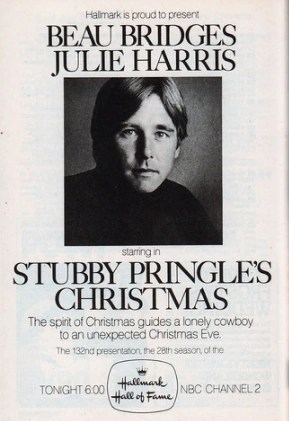
Stubby Pringle’s Christmas

This film aired as a Hallmark Hall of Fame television special in 1978.  It is based on a short story by Jack Schaefer, who wrote the novel Shane (1948), the basis for the 1952 film Shane which many people believe to be one the best Western films ever made.

Stubby Pringle is a young cowboy with unbridled optimism.  We see him in the bunkhouse with two old-timers on the day of Christmas eve.  Stubby has been planning for months to attend the Christmas dance in the community schoolhouse, a twenty-mile ride by horseback.  He has purchased gifts (a box of chocolates and a bolt of dress fabric) for a young woman he met the year before and hopes to see again.

The Christmas eve dance is a celebration of community that Stubby looks forward to for months.  It gives him a chance for romance and the opportunity to eat sweets, dance, and sing, everything a cowboy can’t do stuck on the ranch. 

But on his night-time ride to town he encounters a farm wife chopping wood in a blizzard.  He learns that her husband is very ill, their life has been hard, and they have two small children with nothing to celebrate Christmas. Stubby’s plans change as he offers the gifts of time, labor and emotional support to the farm wife with a broken spirit. 

Stubby Pringle embodies the spirit of Christmas in different ways.  When he asks the farm wife about her tree and presents, she is defensive, she has nothing and replies, “Did you always have a Christmas tree?”  “I never did,” replies Stubby, “that’s how come I know it’s important.”  He believes that children need a Christmas tree with gifts from Santa Claus, in part because he didn’t have Christmas as a child.  Instead of bitterness for his bad turn in life, he embraces the holiday with childlike enthusiasm. 

Stubby shares his positive outlook on life with everyone he encounters, from his bunk mates to the wife of his boss, the lonely farm wife, and even the janitor cleaning up after the dance has concluded.  It reflects the sense of hope that Christmas symbolizes for many, but it transcends December 25 and is Stubby’s philosophy of life; he lives Christmas 365 days a year.  After Stubby describes the hard life of the cowboy and all the “brothers” he knows who have died from pneumonia, cold, heat and even guns, the farm wife observes that he seems to think about death a lot.  Stubby’s response is powerful:  “No ma’am, no, I think mostly about life because I love it.  There ain’t nothing better than waking up and knowing you got a chance at another day.” 

The production embraces the Western genre in many ways, from the 19th century language used by Stubby and others to the casting of character actors with a large body of work in Hollywood Westerns (Strother Martin, Chill Wills).     

Beau Bridges plays Stubby Pringle with a sense of unlimited energy that feels natural for a young cowboy who works hard, cares about others, and hopes for a better life in the future, all of which affirm the ideal of the American Western. 

Ebenezer (1998)

A Christmas Carol has been retold in countless ways with a host of actors taking on the role. An internet search provides many recommendations for the best and/or worst film versions of the classic story.  George C. Scott. Patrick Stewart, and Guy Pearce have appeared in versions committed to historic accuracy while Bill Murray, Jim Carey, Michael Caine, and Henry Winkler appeared in other interpretations of the story.  Even a futuristic sci-fi version written by Rod Serling aired in 1965 (Carol for Another Christmas).

Ebenezer appears to be a classic Hollywood gimmick: set the story of Scrooge in the Old West and portray him as a villain right out of the archetypal Western. “Bah, humbug” is replaced with “hogwash” and Scrooge is decked out in black, including his hat.  But there is something working in this film that sets it apart from other versions of A Christmas Carol.  The story is not simply retold in a dusty 19th century town with cowboys and dance hall girls and gun slingers. The Western genre provides depth to the narrative and in turn enhances the power of the original story.

Scrooge is played by Jack Palance, who achieved prominence as the hired gun in the film version of Shane. Nominated for an Academy Award for this breakout role, Palance made a career by portraying villains.    

Ebenezer Scrooge is a liar, cheat, and thief, who deceived his father-in-law and lost his wife, swindled his dead partner’s daughter out of her inheritance, and cheated at cards to gain a ranch and a horse from a naïve cowboy.  When confronted by his enemies, he turns to physical violence including a willingness to use a gun to get his way. 

Ebenezer was filmed in Canada and the plot explains that Scrooge went from his home in Philadelphia to the West to make his fortune, and after cheating his father-in-law by selling his ranch, he goes to Canada in search of gold.  He owns the local saloon where he spends his days gambling and treating bartender Bob Cratchit as an object of ridicule.

Scrooge isn’t impressed by the visit of Jacob Marlow (Marley) and his warning to change his ways before it is too late.  Scrooge’s response to Marlow is a loud and exaggerated “Blah, blah, blah.”  He makes it clear that he doesn’t fear the prospect of visiting spirits.  To prepare, he cocks his rifle and dares any ghost to “take your best shot.”

The Ghost of Christmas Past addresses a larger issue than Scrooge’s personal history.  Played by a First Nations (Cree) woman, the mere presence of a native figure gives Scrooge pause.  “Are you Pocahontas” he asks.  The spirit replies, “No, but I have met her” and she informs Scrooge of her mission.  “I didn’t know you people celebrated Christmas” he observes.  In an affirmation of the larger meaning of the holiday, the spirit says, “We may not call it Christmas, but we do celebrate friendship and family and love on many levels, but since the arrival of you people the notion of exchanging gifts seems rather appealing.”

The Ghost of Christmas Present uses horseback to transport Scrooge to see the struggles of others in his community and the Ghost of Christmas Future is the faceless, hooded figure that inhabits nearly every version of A Christmas Carol.  Both ghosts perform their duty by showing Scrooge the truth he ignores in the present and the true consequences if he doesn’t make changes in his life.

As expected, Scrooge is transformed by the experience, but the ending again turns the story around to embrace the Western genre.  Instead of simply sharing his good cheer and his wealth, Scrooge is forced to make a life-or-death decision regarding a gun fight of his making.  The film ends not with dinner at nephew Fred’s home but in the community center with everyone in town in attendance.  Scrooge takes on a new role and hopes the stunned community will forgive him for his many sins against humanity, but the crowd is skeptical.  It is only the act of a single child, willing to join Scrooge in a Christmas song, that allows the townspeople to accept and then embrace the transformation of Ebenezer Scrooge.

Christmas and the Cowboy Way

One mark of the lack of appreciation of these films is that they have not been distributed widely. Ebenezer was released as a VHS and later as a DVD but is difficult to locate today.  The film used to play on TNT during the holiday season but seems to have disappeared. However, a version with good quality is available on youtube if you are interested. 

Stubby Pringle’s Christmas has never been released on video and has not been aired in any form that I am aware of since the 1980s.  However devoted fans shared copies for many years.  If you are interested, the film is on youtube and currently available. 

Rhetorical scholar Janice Hocker Rushing studied the Western Myth as constructed in twentieth century films and television and concluded that at its core, the myth centered on the tension between the individual and the community.  This tension is played out in many forms but serves as the primary lens of the Western genre.  Christmas gives two very different characters a chance to share and to receive unconditional love from their own unique community.

Stubby Pringle is an orphan who wants something more than working the range by himself.  He wants a wife, a family, a home, and Christmas gives him a way to express that inner need with others.  While his plans are dramatically changed by his decision to stop and help others, he ends the night with love in his heart.  He has achieved the miracle of Christmas in a small way and can continue to hope for more.

Ebenezer Scrooge is the worst kind of person in any community, he holds power over others through money and possessions and that pursuit has grown from greed to evil incarnate.  He lives in a town but has no presence in the hearts of the people.  It is only when he seeks redemption from the the entire community at the Christmas pageant that he is truly transformed. 

Stubby Pringle epitomizes the Christmas ideal in every way: “to give up one’s very self – to think only of others – how to bring the greatest happiness to others – that is the true meaning of Christmas.” Ebenezer Scrooge has taken the first step toward that ideal if we can trust the words of Charles Dickens, “Scrooge was better than his word. He did it all, and more. . . . He became as good a friend, as good a master, and as good a man as the the good old City knew, or any other good old city or town in the good old world.”

If you get the chance this year, take a chance and watch these two films that truly capture the spirit of Christmas and the cowboy way.

An Analysis of The Card Counter (2021)

Readers Note: This essay contains plot details

By Spencer Short

Introduction

The Card Counter tells the story of a formerly imprisoned solider turned professional gambler named William Tell. He is an enigmatic character, leading a solitary life of travel, gambling, and contemplation. We are introduced to Tell through his narration, beginning and ending in prison. During his eight and a half years of confinement, Tell taught himself to expertly count cards, enabling guaranteed success and control against the house.

Slick, stylish gambling movies are a foundational component of American film culture.  The Card Counter, however, is much different. We do learn tips and tricks about certain games, but the film is more concerned with Tell’s struggle to regain peace of mind and his stolen sense of self. Through Tell’s story, we explore friendship, love, justice, revenge, and responsibility. Finally, we explore forgiveness, the most important theme in the film. Tell is on a journey to save another’s soul, in the wake of unimaginable suffering. Despite the tragic ending, and life lost, a hopeful note remains. William Tell has begun to save himself, as he experiences forgiveness. His forgiveness of self is awakened by forgiveness from another. 

Tell seeks structure, predictability, and anonymity as a way to keep his past at bay. He prefers low-stakes gambling and eschews “celebrity gambling”. He keeps his past completely private, and the person who comes to know him best, La Linda, is still left in the dark for much of the film. She tries to find an opening in his protective shield, and asks if he has been in prison. La Linda is a good poker player, reading Tell immediately. It doesn’t matter to her that he’s been away; she’s just hoping he will share something about his life. “I like to play cards” is really the only thing Tell is willing to share, even as they become increasingly close.

Eventually, we learn that William Tell used to be Private First Class William Tillich. He was trained in interrogation under retired Major John Gordo, who escaped accountability for torture of prisoners during the Iraq War. Tell did not escape, instead sentenced to ten years in military prison for his involvement. Tell’s new life as a professional gambler is upended when he sees Gordo again after several years, leading to an encounter with Cirk Baufort, whose father served with Tell. Cirk’s father and Tell both worked under Gordo in Abu-Ghraib. Cirk blames Gordo for his father’s abusive behavior, alcoholism, and eventual suicide. He hopes to enlist Tell in his quest to punish Gordo. At the same time, Tell begins a professional and personal relationship with La Linda, another professional gambler. In very different ways, each of these characters force Tell to reshape the world he has created for himself.

Purification

The audience quickly gets the sense that Tell is not living a healthy or well-adjusted life. Suffering lurks in the atmosphere, although we do not learn the specifics until later. The film opens with the pure green felt of a casino table – a singular color staged against ominous background music. Purity and purification loom large throughout The Card Counter. Tell’s ritualized purification process – wrapping the contents of his motel room (bed, table, chairs) entirely in white sheets – is performed with the care of religious ceremony. This is a form of sensory deprivation, a technique used in both meditation and torture. Tell may believe that his ritual is meditative, but the audience experiences only alienation. His room becomes ghostlike. It’s unsettling – upon first viewing, we wonder if something more sinister is about to happen. Despite Tell’s efforts, his purified motel room becomes a blank canvas for nightmares of the past.

Archetypes

The four main characters are drawn in an archetypal way – they reflect timeless personal conflicts of humanity. The name William Tell directly references the man who was, according to legend, forced to shoot an apple from his son’s head with bow and arrow as punishment for defiance against government authority. William Tillich likely picked the new name as a direct reference to this legendary character.

Broadly speaking, Tell’s role is that of a martyr, dutifully taking on personal suffering, when others, like Gordo, refuse. Furthermore, in a film with so much poker, it can’t be a coincidence that the main character’s last name is Tell – a poker tell. Tells in poker signal deception, the subject of Gordo’s presentation. Gordo is a personification of wrath and greed left unchecked, taken to their logical extremes. He’s larger than life. He’s “right out of fuckin’ Call of Duty”, as Tell explains to Cirk. 

Gordo’s law enforcement seminar presentation, touting his expertise in security, is a continuous series of hedges. He speaks with a mundane straightforwardness, but upon closer inspection, it’s clear that his software is little better than useless. The developers and Gordo just want an excuse to gain “field experience”. Notably, Tell performs a poker tell as he hears this – rubbing his face. He knows what the rest of the audience doesn’t know (or doesn’t want to admit) – “field experience” is code for torture.

Another main character, La Linda, is archetypal. She is Lady Luck, the muse of gamblers. She even says so directly – “L.L. – like Lucky Lady”. The “La” also indicates a musical quality; her relation to life is playful, unlike Tell. Not only does she provide luck in the form of financial backing for Tell’s big-stakes poker, she becomes Tell’s only real friend. Tell is destined to change upon meeting her.

Throughout the film, Tell tries to include Cirk in his friendship or family with La Linda. Tell longs to mentor Cirk, and help him steer his life right. Tell calls him “the kid” almost exclusively after a certain point in the film, attempting to rewrite his narrative. Everything about Cirk signifies chaotic immaturity. His appearance is unkempt, and he always looks like he just rolled out of bed. His hotel room is a mess. Cirk first shows up at Gordo’s presentation wearing a “Pew Pew Tactical” shirt. Cirk is comfortable openly discussing murder, but for all intents and purposes, he is still just a child playing pretend with finger guns and “pew pew” sound effects.

Clothing is highly symbolic for each character. Tell’s wardrobe consists entirely of muted grays and blacks. This is in stark contrast to every other character in the film – Mr. USA, an obnoxious poker player on the circuit (flashy and exploitative red, white, and blue), La Linda (varied outfits of self-expression), and Cirk (unkempt and juvenile).

Noise and Circles

Tell’s first word to describe his experience in Abu-Ghraib is “noise”. Noise is a recurring theme in The Card Counter – noise that tortures, and noise that heals. Tell thrives in casinos, inherently chaotic environments, but he is careful to never spend the night in a casino hotel, always choosing simple motels miles away instead. As Tell’s arc progresses, he learns to see beauty in noise and chaos. More accurately, he learns that some noise can be beautiful. La Linda takes him to a visit a park “all lit up at night”. She is dressed in white – mirroring Tell’s omnipresent white sheets. Visiting this park with La Linda is a healthy version of the purification ritual.

Tell says that red-black in roulette is “the only smart casino bet”. Spirals and circles figure prominently in the film. Cirk is caught in a downward spiral. His full title – “Cirk with a C” – implies the word “circle” itself. In one of his many efforts to mentor, Tell explains to Cirk that he’s gone “round and round” until he “figured it out”. This is something that Cirk refuses to do – he lets the circle control him, instead of the other way around. In another powerful sequence, Tell’s nightmare scene of suffering prisoners is horrifyingly realistic. The only clue that this is not real is the infinitely warping floor – another set of spirals.

Gambling and Interrogation

Early on in the film, we are introduced to a recurring motif of abstract sound design – it is partly ambiguous, though the sounds seem to depict breathing and desire. It’s an ever-present low level of tension and noise, the aural remnants of Tell’s past. Tell ponders this moral weight in his journal, stating that it can never be removed.

Tell’s concept of “force drift”, something he explains to Cirk, is echoed throughout the film in various forms. Force drift is experienced by interrogators as their increasing efforts to obtain information through torture draw decreasing results. The frustration and power become intoxicating – causing the interrogator to “tilt”. Tell believes he has convinced Cirk to abandon his effort to kidnap and torture Gordo and instead return to college and reestablish a relationship with his estranged mother. When Cirk sends Tell a picture of Gordo’s house, Tell knows that Cirk has lied to him. Tell looks directly at the camera/audience, as if to emphasize that any one of us can tilt, calling to mind a previous scene where he told Cirk exactly that.

In The Card Counter, the present is always subservient to the past, but that connection only becomes clear in the second half of the film.  It is the “weight that can never be removed”. The parallel story of war atrocities and its legacy for America is told in tandem with the story of professional gambling and its normalization as just another form of entertainment.  Casinos are everywhere today and the World Series of Poker is mainstream televised competition, seen on cable television networks devoted to sports.  In the same way that Tell seeks peace through distraction, Americans follow the same path by spending so much time, energy and wealth in the many ubiquitous forms of gambling available. 

Responsibility

Tell tries to convince Cirk to do the right thing. Unfortunately, he uses the wrong methods – methods partly inspired by Gordo’s interrogation training. Tell does not harm Cirk, but we are absolutely convinced that he might. Despite good intentions, and $150,000 in cash, Tell’s help is ultimately reduced to a conditional threat – “I’ll find you”. Tell punctuates the mock interrogation with, “I did this for you”, an obvious contradiction. Tell really does care about Cirk – even when Tell finally connects intimately with La Linda, he prefaces it by mentioning Cirk. The love that Tell has for Cirk doesn’t seem to be enough, though.

Upon first viewing, it seems as if Tell really is going to torture Cirk – he has the right tools, after all, and he seems prepared to act. Tell’s sinister duffel bag – containing gloves, and what appear to be bladed weapons, is omnipresent, since the first motel we see him visit, but there is little attention drawn to this fact. The audience only gets a quick shot of the contents, but that is all that is needed to convey threat. Tell dutifully caries both bags, one in each arm, like the scales of justice. He never lets go of his baggage – he never forgets what happened.

The film does not seem to communicate that Cirk’s fate is inevitable. Everything about the story instead emphasizes Cirk’s potential to make choices and steer his own fate. Cirk just doesn’t have the same perspective as Tell. Cirk is in pain, but he doesn’t realize just how painful life can be – living a life like Tell’s life. Tell tries to warn him, but Cirk cannot listen.

Cirk’s attempt to catch Gordo leads to Cirk’s death. Upon learning the news, Tell tilts a second time, immediately leaving his motel to drive nonstop overnight to Gordo’s home and confront him. Tell lies in wait for Gordo, after purifying the house with white sheets.

“We are each responsible for our own actions”, Gordo states conclusively. Tell agrees, but the difference is clear. Tell had no choice but to take responsibility. Tell served his time.  Gordo never took responsibility – he took every opportunity to advance his career instead. He doesn’t even seem to care about Tell much. Gordo casually dismisses news of Tell’s eight and a half years in prison – “that’s a bitch”. Tell and Gordo step into another room, where unseen torture takes place. Tell calls it a “dramatic reenactment”. After Gordo’s death, Tell continues to take responsibility by reporting the killing to police.

Responsibility is different from justification. Tell says “nothing justified what we did” – something that both Tell and Cirk’s father understood. Something Cirk could have understood, if he was there. Cirk is obsessed with justification – he feels fully justified in his plans to torture and kill Gordo. This is justice, according to Cirk – an eye for an eye. Tell understands that justification doesn’t matter – responsibility does. Tell has figured out a way to manage his relationship with his past, unlike Cirk. Cirk doesn’t respect himself enough to put effort into anything constructive. As Cirk darkly notes, he only has one interest.

Providence and Grace

Tell is an excellent, professional gambler, who can see into other people’s souls. That’s what a good player can do. This skill applies outside of gambling as well, though. Tell sees into Gordo’s soul. He sees Cirk, he sees La Linda. He even sees himself, to some extent. But there is still a missing piece.

In many Paul Schrader films, religion plays an important role. In The Card Counter, Tell does not explicitly identify as a religious person, but one scene in particular is definitely focused on religious imagery. We see Tell, writing in his journal, shirtless. On his back is a prominent tattoo: “I trust my life to Providence. I trust my soul to Grace”. This seems out of place for a professional gambler, who lives by games of chance, but the contrast is powerful when one considers the theological definitions. “Providence” suggests that everything happens for a reason; our lives are part of a larger plan, set in motion by an omnipotent deity. In contrast, “grace” stresses that each person ultimately receives salvation, regardless of their good or bad deeds. This is something dormant in Tell, something that La Linda can realize and activate by forgiving and accepting him.

By trusting his life to providence, Tell understands that forces beyond his control, whether God, government, or fate, have dictated his path. He accepts predestination, which in turn allows him to achieve a degree of balance. In regard to his soul, Tell believes that grace offered by God will provide redemptive salvation regardless of the sins he has committed.  Although he never expresses any sense of spiritual hunger, the idea that he trusts his soul to grace suggests that he can see something beyond the routine of daily life, a final outcome that will offer peace for a life that has been defined by torture. 

Conclusion

When La Linda visits Tell in prison, in the film’s final scene, it calls to mind Tell’s philosophy of forgiveness: forgiving oneself and being forgiven by another should be indivisible. There is a solid glass barrier between them, but the human connection from their fingertips breaks past.The film begins and ends in prison. Something presented first as a continuum – nothing changes. Then “something happens”. Tell reflects back on his first diary entry and first line of the film – “I never imagined myself as someone suited to incarceration”, when he is interrupted by La Linda’s visit. Tell is back in prison, but a fundamental shift has occurred. La Linda has forgiven him, allowing him to forgive himself.

The Card Counter is not a comfortable film to watch, but one that deserves attention. Its deepest lesson lies in its exploration of forgiveness. The Card Counter is worth watching more than once and like all forms of great art its impact will linger long after the first viewing.