Readers Note: This essay contains plot details.
By Brant Short and Spencer Short

In many ways The Holdovers is the ideal Christmas film because it does not try to be a Christmas film. The holiday is not the film’s anchor. Instead, the Christmas season functions as a cultural landscape that provides an important backdrop for the story arc and its emotional tension. The story centers upon personal conflicts that people often face, regardless of the season. The holiday simply opens the door for the narrative, which in turn is grounded in the spirit of Christmas.
A two-week holiday break at an elite New England boarding school creates a situation that none of the principal characters find appealing. A curmudgeonly teacher, an abrasive high school student, and the head cafeteria cook have little in common except their connection to Barton Academy. But each has suffered a loss, creating feelings of isolation, loneliness and bitterness. In the day-to-day life of the school, the teacher, the cook, and the student would likely never achieve any degree of friendship or depth of understanding. But events beyond their control bring them together to live, eat and share personal time for the traditional academic break.
Director Alexander Payne has created a film with a distinct feel for the 1970s. Using relaxed visual pacing and employing patient, stable shots that focus on illuminating character personalities and relationships, the film evokes a strong sense of place and atmosphere. This style gives scenes breathing room to play out, rather than relentlessly pushing forward. There is a wide variety in camera distance from characters, and often, keeping multiple characters within the frame. The Holdover’s cinematography subtly evokes the spirit of 1970s character-study dramas without feeling like a surface-level imitation. The film’s photography creates a visual landscape that viewers might recall from major films of that decade, including Rocky, The Godfather and the Godfather Part II.
An important contextual element is the film’s setting in December 1970 and subtle efforts to reinforce the feeling of nostalgia for a time before social media, cell phones, and influencers. The soundtrack incorporates popular music of the time period (including Cat Stevens, Tony Orlando and Dawn, and the Allman Brothers). Layered within the film are classic Christmas songs (such as “White Christmas” and “The Little Drummer Boy”) that reinforce the cultural context for the story arc. The music is often in the background, with subtle reminders of the season and the era.
Besides well-known songs and artists, the film’s narrative is strengthened by Mark Orton’s original music that employs the comforting overtones of 1970s pop music. Orton’s music gently guides scenes forward and underscores the character’s emotions without feeling like it’s on-the-nose. Orton pulls from 70s tropes – melancholic flute lines as one of the younger boys marches in the snow to throw away his lone glove, optimistic guitar/piano/organ rock for exploring Boston, and so on. These cues are not cheesy 70s sound-alikes however, but tasteful and subtle homages – natural and genuine melodies are prioritized first and foremost, then positioned in period-appropriate instrumentation and production.
The film’s trailer is evocative of the era, both in terms of images and narration. Even the movie rating notice at the beginning of the film uses the industry standard design from 1970.
Paul Hunham (played by Paul Giamatti) teaches classics at Barton Academy, a private boarding school for boys in New England. Clearly Hunham is not well-liked by his students or his colleagues. He lives on campus, and others consider him out of touch with the changing world of education.
Paul has become the school’s pariah. After many years of teaching he finds contemporary students disengaged, lazy, and unintelligent. He despises the headmaster, a former student and does not seem friendly with any faculty. His subject matter ancient history is filled with Greek and Roman philosophers, great battles, and cultural ideals, which hold little currency for his students. Viewers learn that Hanum was a student at Barton several decades earlier and returned after leaving Harvard. When challenged by the headmaster to be more lenient with some students, he pushes back, recalling the school’s vision for academic rigor, high standards, and moral enlightenment. He repeats the mantra “a Barton man never lies” at several opportune situations, only to realize that truth can sometimes be cruel. Without any family, or apparently any friends, Paul plans to spend the break reading mystery novels, enjoying his pipe and a glass of Jim Beam. But the headmaster pressures Paul to serve as the faculty supervisor for students who cannot leave campus over the break. Initially five boys are “holdovers”, but events conspire that force just one student to remain on campus for the entire break.
Mary Lamb (played by Da’Vine Joy Randolph) has worked at Barton for many years, achieving the position as Head Cook in the cafeteria. Mary’s name is highly symbolic. It evokes theological connections to Mary, the mother of Jesus, who is especially revered at Christmas. Her last name “Lamb” is a subtle reminder of an innocent who is gentle but must be part of a larger and often cruel world.
A single mother, from a working-class African American family, Mary sought work at Barton in order to provide a prep school education for her son Curtis, who graduated from Barton in 1969. Unable to afford college tuition, Curtis joined the Army with the goal of using the G.I. Bill for his education when discharged. In an end of the semester school wide memorial service, viewers learn that Curtis was killed in action in the Vietnam War. The war and growing counter-cultural movement of the era seem removed from the daily life of Barton students and faculty. As part of her grieving process, Mary decides to spend Christmas in her campus apartment and avoid visiting her pregnant sister. With five “holdover” students and a faculty supervisor living on campus, Mary must continue her role as cook.
Considered outsiders by the students, the faculty and even the headmaster, Paul and Mary find comfort in sharing their thoughts over bourbon. They do not see themselves as colleagues, or even friends, but their disdain for the world creates understanding and a growing sense of respect for each other. Paul and Mary’s outsider status is reinforced by the fact that the only Barton employees who demonstrate interest toward them are Lydia Crane, the headmaster’s secretary (played by Carrie Preston), and Danny, the school’s custodian (played by Naheem Garcia). In several instances Lydia and Danny offer genuine expressions of warmth, concern, even respect, for Paul and Mary.
Angus Tully (played by Dominic Sessa) is a high school junior, hoping to find a place at Barton. He reveals that he has been kicked out of three previous prep schools and fears the next time will land him in Fork Union, a military academy. Angus is clearly intelligent and witty. At the same time, he prefers to be distant from other students, frustrated by the immaturity and hostility some of them demonstrate. Just as Paul and Mary are clearly outsiders in the school, Angus is disengaged from other students.
Beyond campus, Angus’ personal life is frustrating. He planned to spend the break on a sunny beach with his mother and stepfather, but a last-minute phone call from his mother reveals that he is not welcome. He pleads with his mother to give him a chance to leave campus, to no avail. She had promised him a chance to visit Boston over the break, a visit which becomes increasingly important as the film progresses.
At least, Angus does not have to suffer by himself during break, four other students remain on campus with him. Once again he is the victim of circumstances. When the father of one of the “holdovers” (a corporate CEO with his own private helicopter) shows up and invites the boys to spend break at a ski lodge, all the parents agree to allow their boys to leave campus, except Angus. His mother is unreachable by phone and again, he is denied a real vacation.
As Angus and Paul settle in for an uncomfortable two weeks, with Mary providing their meals, tensions mount. Paul catches Angus on the phone trying to find a hotel room in Boston. In anger at being prevented from leaving campus, Angus brazenly violates a campus rule by running all over Barton and into the gym, separating his shoulder in the process. The injury requires a trip to the emergency ward. When Angus realizes that Paul may be fired because of the accident, he tells the nurse that Paul is his father, his parents are divorced, and reporting the hospital visit to the insurance company would mean he would not see his dad anymore. Paul is shocked by the fabrication but accepts the help of a student who clearly dislikes him as a teacher.
A series of events allow Paul and Angus to form an uneasy understanding of each other, which is often strengthened by Mary’s presence. The three share meals together, spend time watching late night television, and attend a Christmas party hosted by Lydia. The party is festive and filled with Lydia’s friends and family, but no one else from work. Indeed, Lydia comments on the fact that she did not invite anyone else from Barton to her party.
A pivotal moment comes during the party, when Mary, after a number of glasses of whisky, has an emotional breakdown, continuing to grieve for her son. As the three hastily leave the party, tension flares. Angus desperately wants to return to the party because he is finally interacting with someone his age, Lydia’s niece. On the other hand, Paul sees the party as yet another social failure on his part. In frustration he tells Angus that he really wished his father had taken him off campus for break, leading Angus to blurt out: “My father is dead.” Mary chastises Paul for his outburst and they travel back to Barton in silence. The disclosure sets in motion a change in Paul which paves the way for the relational dynamic to change in a positive direction.
The next day, after apparent consideration of his disparaging comments, Paul decides to do something out of character. He drives to town and purchases one of the last, and least attractive, Christmas trees, and returns in triumph, with a lopsided and unadorned tree. Channeling Charlie Brown, Paul is so proud of finding a tree he fails to see its flaws. Just like the Peanuts gang, Mary and Angus find enough decorations for the tree which becomes central to their celebration. They share Christmas dinner, and Paul has gifts for Angus and Mary – copies of Marcus Aurelius’ Meditations for both. As they complete their feast, Angus says, “This is the first time I’ve had a traditional Christmas dinner.” His mother never cooked dinner, he notes, instead she always ordered Christmas dinner from Delmonico’s.
With the good cheer of a shared meal and holiday fellowship in the air, Angus pleads with Paul to take him to Boston. When Paul refuses, Mary steps forward to support the trip. Reluctantly, Paul agrees and Mary decides she would like to visit her sister for Christmas after all. The drive to Boston seems relaxed and genuine, with a deepening friendship among the three evolving. The trip to Boston becomes more than a holiday exercise. A number of events during the trip set in motion self-examination and self-awareness for Paul, Mary and Angus, as well as offering a vehicle for understanding each other’s suffering.
Paul and Angus go bowling, tour a museum of antiquity, which allows Paul to share insights about classical life, and finish the evening with Angus showing his skills at an outdoor skating rank. The night goes sour when a well-dressed man, who is shopping with his wife, recognizes Paul as a fellow undergraduate at Harvard. The wife proudly notes her husband just received tenure at MIT in the field of mathematics. Paul offers a vague description of his life, teaching overseas and holding several fellowships, but he is clearly avoiding any details. Angus comes to the rescue by telling the couple that Paul is his uncle and is working on a scholarly book that will be out soon. He makes the story even more credible by asking Paul to share the title of the intended book, which Paul makes up on the spot: Light and Magic in the Ancient World. The book title might be a fabrication, but it might refer to a monograph that Paul had intended to write when he was younger. For the second time, without warning, Angus has saved Paul from a situation he wanted to avoid.
Afterwards Paul opens up to Angus about his reluctance to share his story. Accused of plagiarism by another Harvard student, who actually committed the act, Paul was expelled from Harvard. The cheater had family connections to Harvard (a building named for the family) and Paul had nothing (his mother died when he was young, he had issues with his father and left home at age 15 to attend Barton). The headmaster, Dr. Green, who had supervised Barton when Paul was a student, was willing to help Paul after the expulsion. Dr. Green hired him as a part-time teacher, eventually becoming full-time. No one at Barton knows about the Harvard story and Paul’s lack of holding a bachelor’s degree. He tells Angus that no one can ever know the truth and Angus seems to understand Paul’s situation.
Paul and Angus decide to see one of the major films of 1970 Little Big Man. During the movie Angus goes to the restroom only to leave the theater, searching for a taxicab. Paul catches him and is outraged, wondering if the positive relationship between the two was just a ruse to escape Barton. Angus finally reveals something about himself that he has been guarding. His father is not physically dead, but in a mental hospital. Paul understands, and they go to the institution together. With great optimism that his father is recovering, Angus is forced to confront the reality of his father’s mental deterioration. Boston offered Angus hope for restoration of his family, which was foreshadowed in a family photo that Angus kept in his room, an important reminder of his past.
Mary’s decision to visit her pregnant sister becomes more than a family holiday celebration. She brings a box of Curtis’ baby items (clothing, toys, a bottle) and in giving the box to her sister, Mary acknowledges that life will go on. There are not many exchanges between Mary and her sister, but we see them sharing love and we sense a small degree of acceptance is beginning for Mary.
Paul, Mary and Angus all have some kind of significant loss in their lives, which shapes their daily existence and colors their relationships.
Paul’s loss emerges from his expulsion from Harvard and retreat to Barton. He guards his secret from colleagues and students, both from fear of losing his job but more importantly fear of ridicule and loss of respect for his status. By sharing his past with Angus, he allows the need for understanding to override his fear of self-disclosure. Angus stepped up for Paul in ways he could not envision doing himself, fostering gratitude toward another person, an uncommon emotion for Paul.
Mary’s loss is public, the death of her son in war. But there is the deeper guilt that her son could not afford the college education he wanted after graduation and thus could not get a student deferment. His plan to use the GI Bill made sense, but it was grounded in the fact that in an elite school with students of wealth and privilege, Curtis only had Mary’s support for his future. Sharing time with Paul and Angus allows Mary to find something positive at Barton and in turn see the importance of allowing others into her life.
Angus has lost more than his father, he has lost his family. The photo of himself and his parents, that he clearly values, is a reminder of a family that no longer exists. His mother has divorced his father and remarried, which is why she refuses to allow Angus to spend Christmas vacation with her. She wants time alone with her new husband and tells Angus he must wait until summer to come home. Angus holds out hope for a positive change in his father’s mental condition, but the trip to Boston reveals this is unlikely.
On the return trip to Barton, Angus is both despondent (about his father’s condition) and fearful (that he might be destined to the same illness). He tells Paul that he has been a terrible person who lies and steals and maybe deserves an unhappy life. In a new role for himself, Paul shows compassion and demonstrates genuine concern for Angus. Paul is adamant that no child is predestined for a path in life because of a parent. People make their own way and Paul insists Angus has much to offer. His future can be bright.
The feelings of renewal and comradery that the trio have are short-lived. Upon returning to campus, Angus’ mother and stepfather appear, appropriately driving a luxury car. Paul is summoned to the headmaster’s office where he learns that Angus was not supposed to see his father and the visit ended in violence, with his father throwing a snow globe he was given by Angus. His mother is outraged because she will have to move her ex-husband to another facility. The parents want to blame Angus for manipulating Paul and punish him by sending him to military school. Shocked by their response, Paul urges the parents to reconsider their plan, emphasizing Angus’ intelligence and potential to excel at Barton. Sensing their decision to remove Angus is final, Paul makes a fateful decision. He tells the headmaster and parents the trip to the mental hospital was all his idea, that he pressured Angus to visit his father, and he accepts the entire blame. The self-sacrifice works. Angus gets to stay at Barton, but Paul is fired and must leave campus as soon as possible.
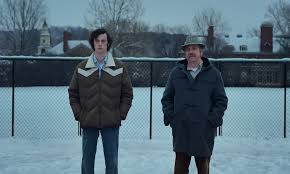
The final scene of Paul loading a U-Trailer with his belongings is both poignant and inspiring. The two exchange a few comments, with neither expressing the depth of emotion that is embedded in the subtext of the conversation. Paul is not sure of his future plans but is thinking of traveling and maybe even writing the book he had planned decades earlier. Their final handshake and direct eye contact provides the emotional closure that both seek in this encounter. Their words to each other are both poignant in the moment and symbolic of their relationship. Angus offers “see ya” like a student expecting to see his teacher during the next term. But Paul says “see ya” with a sense of finality and total closure.
As Paul drives away from campus, he stops his car and rolls down his window, offering a final goodbye to the institution with a small act of defiance.
The Holdovers not only takes place during the Christmas holiday, but its inherent moral quality is grounded in the ideals of the holiday. Three unlikely people are drawn together because of the Christmas season and their challenges in life become the catalyst for finding hope and renewal in the new year. Over a short two-week period, each person changes and in turn helps the others change in very meaningful ways. The gifts of love, compassion and understanding emerge through their shared struggles and miscues, created by Christmas but that will last well beyond December 1970.
 Critical Rewind