The Holdovers (2023): A Christmas Parable

Readers Note: This essay contains plot details.

By Brant Short and Spencer Short

In many ways The Holdovers is the ideal Christmas film because it does not try to be a Christmas film. The holiday is not the film’s anchor. Instead, the Christmas season functions as a cultural landscape that provides an important backdrop for the story arc and its emotional tension. The story centers upon personal conflicts that people often face, regardless of the season. The holiday simply opens the door for the narrative, which in turn is grounded in the spirit of Christmas.

A two-week holiday break at an elite New England boarding school creates a situation that none of the principal characters find appealing. A curmudgeonly teacher, an abrasive high school student, and the head cafeteria cook have little in common except their connection to Barton Academy. But each has suffered a loss, creating feelings of isolation, loneliness and bitterness. In the day-to-day life of the school, the teacher, the cook, and the student would likely never achieve any degree of friendship or depth of understanding. But events beyond their control bring them together to live, eat and share personal time for the traditional academic break.

Director Alexander Payne has created a film with a distinct feel for the 1970s. Using relaxed visual pacing and employing patient, stable shots that focus on illuminating character personalities and relationships, the film evokes a strong sense of place and atmosphere. This style gives scenes breathing room to play out, rather than relentlessly pushing forward. There is a wide variety in camera distance from characters, and often, keeping multiple characters within the frame. The Holdover’s cinematography subtly evokes the spirit of 1970s character-study dramas without feeling like a surface-level imitation. The film’s photography creates a visual landscape that viewers might recall from major films of that decade, including Rocky, The Godfather and the Godfather Part II.

An important contextual element is the film’s setting in December 1970 and subtle efforts to reinforce the feeling of nostalgia for a time before social media, cell phones, and influencers. The soundtrack incorporates popular music of the time period (including Cat Stevens, Tony Orlando and Dawn, and the Allman Brothers). Layered within the film are classic Christmas songs (such as “White Christmas” and “The Little Drummer Boy”) that reinforce the cultural context for the story arc. The music is often in the background, with subtle reminders of the season and the era.

Besides well-known songs and artists, the film’s narrative is strengthened by Mark Orton’s original music that employs the comforting overtones of 1970s pop music. Orton’s music gently guides scenes forward and underscores the character’s emotions without feeling like it’s on-the-nose. Orton pulls from 70s tropes – melancholic flute lines as one of the younger boys marches in the snow to throw away his lone glove, optimistic guitar/piano/organ rock for exploring Boston, and so on. These cues are not cheesy 70s sound-alikes however, but tasteful and subtle homages – natural and genuine melodies are prioritized first and foremost, then positioned in period-appropriate instrumentation and production.

The film’s trailer is evocative of the era, both in terms of images and narration. Even the movie rating notice at the beginning of the film uses the industry standard design from 1970.

Paul Hunham (played by Paul Giamatti) teaches classics at Barton Academy, a private boarding school for boys in New England. Clearly Hunham is not well-liked by his students or his colleagues. He lives on campus, and others consider him out of touch with the changing world of education.

Paul has become the school’s pariah. After many years of teaching he finds contemporary students disengaged, lazy, and unintelligent. He despises the headmaster, a former student and does not seem friendly with any faculty. His subject matter ancient history is filled with Greek and Roman philosophers, great battles, and cultural ideals, which hold little currency for his students. Viewers learn that Hanum was a student at Barton several decades earlier and returned after leaving Harvard. When challenged by the headmaster to be more lenient with some students, he pushes back, recalling the school’s vision for academic rigor, high standards, and moral enlightenment. He repeats the mantra “a Barton man never lies” at several opportune situations, only to realize that truth can sometimes be cruel. Without any family, or apparently any friends, Paul plans to spend the break reading mystery novels, enjoying his pipe and a glass of Jim Beam. But the headmaster pressures Paul to serve as the faculty supervisor for students who cannot leave campus over the break. Initially five boys are “holdovers”, but events conspire that force just one student to remain on campus for the entire break.

Mary Lamb (played by Da’Vine Joy Randolph) has worked at Barton for many years, achieving the position as Head Cook in the cafeteria. Mary’s name is highly symbolic. It evokes theological connections to Mary, the mother of Jesus, who is especially revered at Christmas. Her last name “Lamb” is a subtle reminder of an innocent who is gentle but must be part of a larger and often cruel world.

A single mother, from a working-class African American family, Mary sought work at Barton in order to provide a prep school education for her son Curtis, who graduated from Barton in 1969. Unable to afford college tuition, Curtis joined the Army with the goal of using the G.I. Bill for his education when discharged. In an end of the semester school wide memorial service, viewers learn that Curtis was killed in action in the Vietnam War. The war and growing counter-cultural movement of the era seem removed from the daily life of Barton students and faculty. As part of her grieving process, Mary decides to spend Christmas in her campus apartment and avoid visiting her pregnant sister. With five “holdover” students and a faculty supervisor living on campus, Mary must continue her role as cook.

Considered outsiders by the students, the faculty and even the headmaster, Paul and Mary find comfort in sharing their thoughts over bourbon. They do not see themselves as colleagues, or even friends, but their disdain for the world creates understanding and a growing sense of respect for each other. Paul and Mary’s outsider status is reinforced by the fact that the only Barton employees who demonstrate interest toward them are Lydia Crane, the headmaster’s secretary (played by Carrie Preston), and Danny, the school’s custodian (played by Naheem Garcia). In several instances Lydia and Danny offer genuine expressions of warmth, concern, even respect, for Paul and Mary.

Angus Tully (played by Dominic Sessa) is a high school junior, hoping to find a place at Barton. He reveals that he has been kicked out of three previous prep schools and fears the next time will land him in Fork Union, a military academy. Angus is clearly intelligent and witty. At the same time, he prefers to be distant from other students, frustrated by the immaturity and hostility some of them demonstrate. Just as Paul and Mary are clearly outsiders in the school, Angus is disengaged from other students.

Beyond campus, Angus’ personal life is frustrating. He planned to spend the break on a sunny beach with his mother and stepfather, but a last-minute phone call from his mother reveals that he is not welcome. He pleads with his mother to give him a chance to leave campus, to no avail. She had promised him a chance to visit Boston over the break, a visit which becomes increasingly important as the film progresses.

At least, Angus does not have to suffer by himself during break, four other students remain on campus with him. Once again he is the victim of circumstances. When the father of one of the “holdovers” (a corporate CEO with his own private helicopter) shows up and invites the boys to spend break at a ski lodge, all the parents agree to allow their boys to leave campus, except Angus. His mother is unreachable by phone and again, he is denied a real vacation.

As Angus and Paul settle in for an uncomfortable two weeks, with Mary providing their meals, tensions mount. Paul catches Angus on the phone trying to find a hotel room in Boston. In anger at being prevented from leaving campus, Angus brazenly violates a campus rule by running all over Barton and into the gym, separating his shoulder in the process. The injury requires a trip to the emergency ward. When Angus realizes that Paul may be fired because of the accident, he tells the nurse that Paul is his father, his parents are divorced, and reporting the hospital visit to the insurance company would mean he would not see his dad anymore. Paul is shocked by the fabrication but accepts the help of a student who clearly dislikes him as a teacher.

A series of events allow Paul and Angus to form an uneasy understanding of each other, which is often strengthened by Mary’s presence. The three share meals together, spend time watching late night television, and attend a Christmas party hosted by Lydia. The party is festive and filled with Lydia’s friends and family, but no one else from work. Indeed, Lydia comments on the fact that she did not invite anyone else from Barton to her party.

A pivotal moment comes during the party, when Mary, after a number of glasses of whisky, has an emotional breakdown, continuing to grieve for her son. As the three hastily leave the party, tension flares. Angus desperately wants to return to the party because he is finally interacting with someone his age, Lydia’s niece. On the other hand, Paul sees the party as yet another social failure on his part. In frustration he tells Angus that he really wished his father had taken him off campus for break, leading Angus to blurt out: “My father is dead.” Mary chastises Paul for his outburst and they travel back to Barton in silence. The disclosure sets in motion a change in Paul which paves the way for the relational dynamic to change in a positive direction.

The next day, after apparent consideration of his disparaging comments, Paul decides to do something out of character. He drives to town and purchases one of the last, and least attractive, Christmas trees, and returns in triumph, with a lopsided and unadorned tree. Channeling Charlie Brown, Paul is so proud of finding a tree he fails to see its flaws. Just like the Peanuts gang, Mary and Angus find enough decorations for the tree which becomes central to their celebration. They share Christmas dinner, and Paul has gifts for Angus and Mary – copies of Marcus Aurelius’ Meditations for both. As they complete their feast, Angus says, “This is the first time I’ve had a traditional Christmas dinner.” His mother never cooked dinner, he notes, instead she always ordered Christmas dinner from Delmonico’s.

With the good cheer of a shared meal and holiday fellowship in the air, Angus pleads with Paul to take him to Boston. When Paul refuses, Mary steps forward to support the trip. Reluctantly, Paul agrees and Mary decides she would like to visit her sister for Christmas after all. The drive to Boston seems relaxed and genuine, with a deepening friendship among the three evolving. The trip to Boston becomes more than a holiday exercise. A number of events during the trip set in motion self-examination and self-awareness for Paul, Mary and Angus, as well as offering a vehicle for understanding each other’s suffering.

Paul and Angus go bowling, tour a museum of antiquity, which allows Paul to share insights about classical life, and finish the evening with Angus showing his skills at an outdoor skating rank. The night goes sour when a well-dressed man, who is shopping with his wife, recognizes Paul as a fellow undergraduate at Harvard. The wife proudly notes her husband just received tenure at MIT in the field of mathematics. Paul offers a vague description of his life, teaching overseas and holding several fellowships, but he is clearly avoiding any details. Angus comes to the rescue by telling the couple that Paul is his uncle and is working on a scholarly book that will be out soon. He makes the story even more credible by asking Paul to share the title of the intended book, which Paul makes up on the spot: Light and Magic in the Ancient World. The book title might be a fabrication, but it might refer to a monograph that Paul had intended to write when he was younger. For the second time, without warning, Angus has saved Paul from a situation he wanted to avoid.

Afterwards Paul opens up to Angus about his reluctance to share his story. Accused of plagiarism by another Harvard student, who actually committed the act, Paul was expelled from Harvard. The cheater had family connections to Harvard (a building named for the family) and Paul had nothing (his mother died when he was young, he had issues with his father and left home at age 15 to attend Barton). The headmaster, Dr. Green, who had supervised Barton when Paul was a student, was willing to help Paul after the expulsion. Dr. Green hired him as a part-time teacher, eventually becoming full-time. No one at Barton knows about the Harvard story and Paul’s lack of holding a bachelor’s degree. He tells Angus that no one can ever know the truth and Angus seems to understand Paul’s situation.

Paul and Angus decide to see one of the major films of 1970 Little Big Man. During the movie Angus goes to the restroom only to leave the theater, searching for a taxicab. Paul catches him and is outraged, wondering if the positive relationship between the two was just a ruse to escape Barton. Angus finally reveals something about himself that he has been guarding. His father is not physically dead, but in a mental hospital. Paul understands, and they go to the institution together. With great optimism that his father is recovering, Angus is forced to confront the reality of his father’s mental deterioration. Boston offered Angus hope for restoration of his family, which was foreshadowed in a family photo that Angus kept in his room, an important reminder of his past.

Mary’s decision to visit her pregnant sister becomes more than a family holiday celebration. She brings a box of Curtis’ baby items (clothing, toys, a bottle) and in giving the box to her sister, Mary acknowledges that life will go on. There are not many exchanges between Mary and her sister, but we see them sharing love and we sense a small degree of acceptance is beginning for Mary.

Paul, Mary and Angus all have some kind of significant loss in their lives, which shapes their daily existence and colors their relationships.

Paul’s loss emerges from his expulsion from Harvard and retreat to Barton. He guards his secret from colleagues and students, both from fear of losing his job but more importantly fear of ridicule and loss of respect for his status. By sharing his past with Angus, he allows the need for understanding to override his fear of self-disclosure. Angus stepped up for Paul in ways he could not envision doing himself, fostering gratitude toward another person, an uncommon emotion for Paul.

Mary’s loss is public, the death of her son in war. But there is the deeper guilt that her son could not afford the college education he wanted after graduation and thus could not get a student deferment. His plan to use the GI Bill made sense, but it was grounded in the fact that in an elite school with students of wealth and privilege, Curtis only had Mary’s support for his future. Sharing time with Paul and Angus allows Mary to find something positive at Barton and in turn see the importance of allowing others into her life.

Angus has lost more than his father, he has lost his family. The photo of himself and his parents, that he clearly values, is a reminder of a family that no longer exists. His mother has divorced his father and remarried, which is why she refuses to allow Angus to spend Christmas vacation with her. She wants time alone with her new husband and tells Angus he must wait until summer to come home. Angus holds out hope for a positive change in his father’s mental condition, but the trip to Boston reveals this is unlikely.

On the return trip to Barton, Angus is both despondent (about his father’s condition) and fearful (that he might be destined to the same illness). He tells Paul that he has been a terrible person who lies and steals and maybe deserves an unhappy life. In a new role for himself, Paul shows compassion and demonstrates genuine concern for Angus. Paul is adamant that no child is predestined for a path in life because of a parent. People make their own way and Paul insists Angus has much to offer. His future can be bright.

The feelings of renewal and comradery that the trio have are short-lived. Upon returning to campus, Angus’ mother and stepfather appear, appropriately driving a luxury car. Paul is summoned to the headmaster’s office where he learns that Angus was not supposed to see his father and the visit ended in violence, with his father throwing a snow globe he was given by Angus. His mother is outraged because she will have to move her ex-husband to another facility. The parents want to blame Angus for manipulating Paul and punish him by sending him to military school. Shocked by their response, Paul urges the parents to reconsider their plan, emphasizing Angus’ intelligence and potential to excel at Barton. Sensing their decision to remove Angus is final, Paul makes a fateful decision. He tells the headmaster and parents the trip to the mental hospital was all his idea, that he pressured Angus to visit his father, and he accepts the entire blame. The self-sacrifice works. Angus gets to stay at Barton, but Paul is fired and must leave campus as soon as possible.
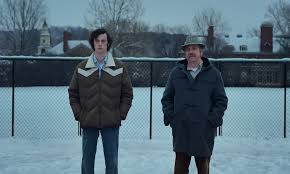
The final scene of Paul loading a U-Trailer with his belongings is both poignant and inspiring. The two exchange a few comments, with neither expressing the depth of emotion that is embedded in the subtext of the conversation. Paul is not sure of his future plans but is thinking of traveling and maybe even writing the book he had planned decades earlier. Their final handshake and direct eye contact provides the emotional closure that both seek in this encounter. Their words to each other are both poignant in the moment and symbolic of their relationship. Angus offers “see ya” like a student expecting to see his teacher during the next term. But Paul says “see ya” with a sense of finality and total closure.

As Paul drives away from campus, he stops his car and rolls down his window, offering a final goodbye to the institution with a small act of defiance.

The Holdovers not only takes place during the Christmas holiday, but its inherent moral quality is grounded in the ideals of the holiday. Three unlikely people are drawn together because of the Christmas season and their challenges in life become the catalyst for finding hope and renewal in the new year. Over a short two-week period, each person changes and in turn helps the others change in very meaningful ways. The gifts of love, compassion and understanding emerge through their shared struggles and miscues, created by Christmas but that will last well beyond December 1970.

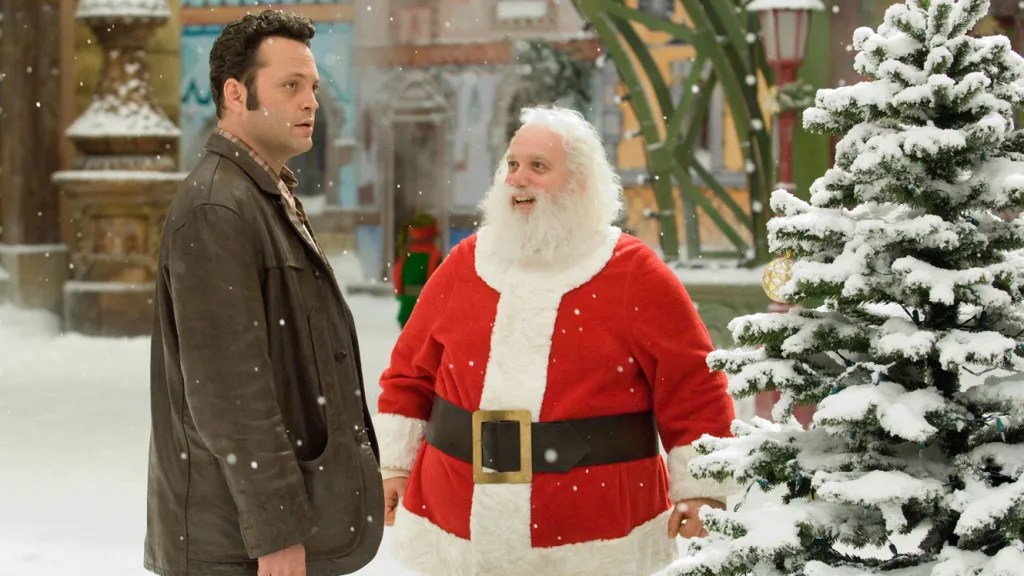
A Santa Sampler: The Twilight Zone (1960); Fred Claus (2007)

Readers Note: This essay contains plot details

Brant Short

Santa Claus may be the most recognized image of the Christmas holiday, even more well-known than images surrounding the birth of Christ. Celebrating Christmas has become a cultural event, with Santa becoming one of its iconic symbols. Christmas has become a “season” that begins in October (and earlier for some) and shapes many aspects of popular culture, commerce, and travel.

For many people, three ideals define Christmas, regardless of one’s faith and beliefs.  Christmas offers a communal time for gatherings of friends and family.  Although other holidays may include family and friends, December 25 has a unique place in Western culture for celebrating the blessings of life, whatever they might be. In addition, Christmas promotes a norm of sharing gifts, tangible symbols to acknowledge the importance of others in our life. Finally, Christmas highlights the importance of giving children a sense of belonging and hope.

Santa Claus often personifies these ideals in various ways he is presented in popular culture, including film and television. Cinematic versions of Santa often have several common elements. Santa exudes compassion and understanding with a touch of mysticism. He refuses to accept the cynical views of unbelievers and in turn helps them find the true spirit of Christmas. Because Santa somehow knows our fears, experiences and secrets, he also knows what we need for happiness. 

The archetypal cinema Santa is most likely Kris Kringle from Miracle on 34th Street. The 1947 film presented a cinematic Santa that has served as a touchstone for generations of viewers and filmmakers. Set in New York City, the “real” Santa is named Kris Kringle, a kindly old gentleman who works as a department store Santa. Kris helps a young girl who does not believe in Santa learn the true meaning of Christmas, even in the midst of adults who reject Santa’s existence. Kris Kringle displays kindness and compassion, even when challenged from many quarters. Kris appears to have a supernatural gift; knowledge of what people really need as well as the means to achieve happiness.

One can find multiple lists of the “best” cinema Santas on the internet, often with a focus on the individual actor playing Santa. Although many of these Santas offer unique and entertaining ways to understand Christmas, two Santa stories stand out for me: “The Night of the Meek”, a 1960 episode of The Twilight Zone and Fred Claus, a 2007 film.

Like other cinematic portrayals of Santa Claus, “The Night of the Meek” and Fred Claus explore the misplaced values and practices that often shape contemporary views of Christmas. But a closer consideration of the two stories suggests something deeper, a critique that goes to the heart of what Christmas should mean and challenges viewers to become self-reflective regarding their own approaches to the holiday.

“The Night of the Meek” The Twilight Zone (1960)

In season two of The Twilight Zone, Rod Serling wrote a Christmas episode consistent with his penchant for social critique. Starring Art Carney as Henry Corwin, a down-on-the-luck department store Santa Claus, “The Night of the Meek” confronts the tension between the ideals of Christmas and the reality of the holiday’s focus on consumption and materialism.

Unlike the kindly and all-knowing department store Santa in Miracle on 34th Street, Corwin is embittered and angry, clearly intoxicated before going to work as Santa Claus in a crowded department store on Christmas Eve. Stumbling down the street, he falls and is confronted by two children who ask for various toys and then ask for a turkey for Christmas dinner and finally “please Santa, a job for my daddy.” This interaction only reinforces his downward spiral as he heads for work.

But before he can get seated and interact with the children, Corwin slips and falls. A pretentious boy calls out that Santa is “loaded” and his mother in turn creates a scene. Trying to mollify the irate customer, Corwin’s supervisor fires him on the spot. A store full of children and parents witness Corwin’s effort to apologize for his behavior. He observes that “I can either drink or weep and drinking is so much more subtle.” But he continues, in an effort to explain the larger truth of Christmas hypocrisy.

He offers a simple yet eloquent indictment of celebrating Christmas in a world filled with poverty and economic disparity. Acknowledging that his drinking was wrong, Corwin notes that he was not rude to the mother and explains he only wanted to “remind her that Christmas is more than barging up and down department aisles and pushing people out of the way.”  Indeed, Corwin believes that “someone has to tell her that Christmas is another thing finer than that, richer, finer, truer and it should come with patience, and love, charity, compassion. That’s what I would have told her is she had given me a chance.”

Calling himself an “aging purposeless relic of another time”, Corwin explains that he lives in a “dirty rooming” house on a street “filled with hungry kids.” The only thing that might come down their chimney on Christmas Eve is “more poverty.” He drinks to help forget where he lives and to imagine living at the North Pole with the neighborhood children as his elves. His only wish is that one Christmas “that I could see some of the hopeless ones and the dreamless one just Christmas. I’d like to see the meek inherit the earth. And that’s why I drink and that’s why I weep.”

Returning to the tavern, the bartender tells him to get lost and he wanders into a deserted alley, only to find a stray cat and bag filled with garbage. Sleigh bells ring and the bag is somehow transformed into a bag of presents. But not only presents, but the exact present each person requests. Becoming a real Santa, Corwin passes out gifts to the street children and heads for Christmas Eve service at the Salvation Army. While the poor and disposed are happy to receive his gifts, others question Corwin’s honesty. The Salvation Army leader, a police officer, and his former supervisor assume that Corwin’s bag is filled with stolen merchandise. Only through the magic of Christmas do the unbelievers come to see the truth. As he completes his task and has an empty bag, Corwin is asked by one of the men at the shelter what he would like for Christmas. Corwin does not wish for gifts, “I only wish I could do this every year.” As the story ends, we see that Corwin is granted his wish.

Rod Serling gets the final word, as his typical in each episode of The Twilight Zone:

A word to the wise to all the children of the twentieth century, whether their concern be pediatrics or geriatric, whether they crawl on hands and knees and wear diapers or walk with a cane and comb their beards. There’s a wondrous magic to Christmas and there’s a special power reserved for little people. In short, there’s nothing mightier than the meek. And a Merry Christmas to each and all.

In “The Night of the Meek” Santa is presented as a failure, indeed a fraud, for those living on the margins. Corwin says he can only weep for those forgotten by society, the only thing they will get for Christmas is more poverty. By the same token, Corwin drinks to forget the economic disparity that is highlighted by the holiday.

The excess of Christmas celebration, shown in an active department story filled with toys, children, and well-to-do parents is in contrast with children on the street, only seeking food for the family and a job for a parent. Beyond the department store, the rest of the episode takes place in an urban neighborhood, where we see the trappings of a difficult life. Children outside in the snow, looking for help. A Salvation Army shelter filled with men with little hope. A police station. A tavern with three patrons, one passed out, drinking to welcome Christmas.

Only through the spirit of Christmas do we encounter the holiday’s real meaning: to share our world of plenty with those in need and embrace its foundational values of love, charity and compassion. Serling’s final words underline his message. Christmas reserves its “special power” for the “little people.”  Importantly, Serling believes that all people need to embrace the power of Christmas, whether they wear diapers or walk with canes, whether their concern may be “pediatrics or geriatrics” he is addressing them. Christmas should be a time to honor the “meek” of the world and allow them to share in the bounty so many others take for granted. 

Although Serling was not considered an active Christian, he obviously understood the power of scripture as a means of sharing an idea most Americans in 1960s would be familiar with. He is referencing the biblical book of Mark (chapter 5, verses 2-11), better known as the “Sermon the Mount.” More specially, the claim that the “meek will inherit the earth” is found in a larger section that considers both economic and spiritual poverty that many people face.

Blessed are the poor in spirit, for theirs is the kingdom of heaven.
are those who mourn, for they shall be comforted.
Blessed are the meek, for they shall inherit the earth.
Blessed are those who hunger and thirst for righteousness,
for they shall be satisfied.
Blessed are the merciful, for they shall receive mercy

While theologians can assess the deeper cultural and religious implications of this passage, I believe that Serling wanted this particular verse to serve two functions. At one level, it articulates the disconnect between how Americans in 1960 celebrated Christ’s birth with the values preached by Jesus. At another level, by calling Christmas Eve the “night of the meek” the story suggests it can be the time and place for transformation, if only people are willing to change.   

Fred Claus (2007)

Fred Claus fulfills many of the conventions of the Santa Claus narrative. Santa is threatened in his effort to continue delivering presents on Christmas eve. Santa has a supportive spouse and hard-working elves who will do anything to help him deal with such challenges. Santa encounters and helps an embittered/cynical person understand the real meaning of Christmas. Santa saves Christmas for one more year. Except in Fred Claus Santa does not really save Christmas, his older brother Fred is the hero who steps in when Nick is incapacitated on Christmas Eve.

On the surface, Fred Claus is a predictable Hollywood effort to produce a Christmas film with a unique hook. Telling a familiar story through the eyes of Santa’s brother, the film still centers on fulfilling Santa’s mission to deliver presents, amidst a crisis, to all the good children of the world. But a closer examination of the film reveals a commentary on family, friendship, and unconditional love that transcends the Santa narrative.

The film opens in a fairy tale world of a cozy family cottage set in a beautiful forest. We see the birth of Nicholas and his special place in the world. Not only is he the “fattest” baby ever seen by the midwife, but he does not cry. A smiling newborn, he utters his first words, “Ho….Ho, Ho.” Holding the newborn infant, Nick’s mother establishes his life trajectory: “He’s perfect in every way. . .. My Saint Nicholas.”

We also learn that Fred loved his brother and made a promise to be the “best big brother in the whole world.” But as Nick continues to demonstrate his special qualities of generosity, Fred is ignored and told to “be more like your brother.” The last straw comes when Nick chops down Fred’s favorite tree to bring it in the house for Christmas, not realizing the tree was home to a bird that Fred had adopted. As the tree fell to the ground, the bird house was destroyed, and “Chirp Chip” flew away to never return. The narrator tells us that after this event Fred “began to resent his brother, his parents, and even his life. And like many unhappy children he became angry. Even naughty.” While Fred grew more bitter, Nick grew generous and eventually “fulfilled his mother’s prophecy. In manhood, he literally became a saint.”

Before moving to the present day and telling Fred’s story, the narrator adds an important piece of information.

It’s a little-known rule of Sainthood but when you become a saint you freeze in time and become eternally ageless. The rule applies to the family of the saint and the spouses as well.

The film transitions to modern day Chicago with Fred acting as a Scrooge-like repo man, explaining to a little girl that people who don’t pay their bills deserve what they get. Fred lives on the fringes of truth, working scams to get enough money to put a down payment on a business property. While Nick has become Santa Claus who lives at the North Pole, manages hundreds of elves, and delivers presents to children around the world at Christmas, Fred has become a debt collector who seems to be always on the make with everyone, including his girlfriend.

After one scam ends in his arrest, Fred is forced to ask Nick for $5,000 bail money. Sensing Nick’s willingness to pay his bail, Nick decides to go for broke and ask for an additional $50,000 in order to start a new business, an Off-Track Betting parlor. Nick is skeptical and finally says yes, but only if Fred will travel to the North Pole and help prepare for Christmas. Fred is reluctant, but needs the cash so agrees.

Fred’s bitterness toward Christmas emerges when a young neighbor boy, Samual “Slam” Gibbons drops by and asks Fred for advice. Slam wants a puppy for Christmas, but is concerned Santa won’t find him, as Slam sometimes stays with his grandmother and sometimes he stays with his mom at her boyfriend’s apartment. Instead of reassuring this ten-year-old boy, Fred tells Slam to understand the truth about Santa:

The guy’s in a big red suit and flies around because he craves the spotlight. He’s a fame junkie. The guy’s a clown. He a megalomaniac. It’s a shell game.

We learn that Santa is stressed as the elves are 2% behind their quota for gifts. But then things get worse. An efficiency expert arrives with plans to shut down Santa’s workshop if it continues to have problems. He puts Santa on notice, “three strike and you’re out.”  The expert plans to “streamline” and “outsource” and use the South Pole as a new operation without Santa or his elves. The expert forbids Santa from telling anyone about the assessment, which adds to his stress level. 

Fred learns that the elves hand-make a present for every child because its “important to Santa that every child feels taken care.” Nick tells Fred that the “Naughty-Nice Department is the key to the whole operation” and children are constantly being monitored to see where they are on this list. Indeed, there is a “Ten Most Naughty List” that is always be updated. Fred is charged with reviewing files and stamping them either “Nice” or “Naughty.” This is essential, Santa says, because “We are not here to give every child every toy that they want. . .. Part of Christmas is being grateful for the things we can have.”

Fred’s visit worsens as he is forced to attend dinner with his mother and father, who he has avoided at all costs for years. Fred’s mother returns to form, criticizing Fred and praising Nick, uttering the same words that angered Fred as a child: “Why can’t you be more like your brother?”

Fred’s efforts to improve working conditions backfire and chaos ensues, threatening production goals. As he returns to his job reviewing files for the “Naughty-Nice” list he sees that his neighbor Slam has become number one on the “Naughty” list. Placed in an orphanage because of an unfit home, Slam tells the other orphans that “Santa is a clown. He’s a fame junkie. It’s a shell game.” Fred’s words come back to him with force, and he determines that every file will be stamped “Nice” and every child should receive a gift.

However, the elves cannot make enough presents for every child, and it appears that this will be Santa’s last Christmas. By not fulfilling Christmas delivery, the North Pole will close, and operations will be streamlined and outsourced and be moved to the South Pole. This leads to a violent confrontation between the brothers that ends with Nick saying, “I didn’t know you hated me.” Fred’s response is cutting: “I don’t hate you, Nick. I just wish you were never born.”  Nick limps back to his house and Fred takes his money and returns to Chicago.

Two pivotal events occur that transform Fred’s view of his brother and his own behavior. First, Fred opens a gift that Mrs. Claus gave him as he left the North Pole. It contains a new birdhouse and a note of apology: “I’m sorry I cut down your tree. Nick.” Since boyhood, Fred believed that Nick didn’t understand the impact of cutting down the tree and why it meant so much to Fred.

Not sure of his feelings after opening the gift, Fred wanders into a “Siblings Anonymous” meeting where the siblings of famous people express feelings. Several real brothers appear in this scene (brothers of Alec Baldwin and Sylvester Stallone) as well as Bill Clinton’s younger brother, Roger. As tensions arise in the session, prompted by Fred’s demand for attention, Roger Clinton stands and offers a heartfelt message about the importance of family:

I used to be really really angry with my brother. I didn’t want to become the first brother, especially for the rest of my life. I couldn’t control being brother of the president of the United States. But I could continue being Bill Clinton’s brother. And I made a decision, even though I could have brought the house down, I made a decision that for the love of my brother and for the love my family name that I was gonna do whatever it took because I loved my brother and I was always gonna be there for my brother. And I have been, and you know what, you can too.

Realizing his own anger was misplaced and that Nick needs help, Fred decides to use his $50,000 to get back to the North Pole as soon as possible and help save Christmas. This time Fred becomes the generous brother. When the elves say they cannot make enough presents in ten hours to meet demand, Fred has a plan. Instead of trying to honor every different request, if the elves make one toy for all boys and one toy for all girls, then each child gets something for Christmas. Willie, the head elf responds, “It’s not what the kids asked for.”  Fred explains the real meaning of Christmas is not the gift, but the act of giving.

All that matters is that each of the kids gets a toy. That they all have something that they can open when they wake up in the morning. Most importantly, they will know that there’s somebody out there who’s thinking about them.

The elves agree that in ten hours they can produce enough baseball bats for boys and hula hoops for girls so Christmas Eve deliveries are possible.

But when Nick is unable to deliver the presents because of a bad back, everyone turns to Fred, because only a Claus is allowed to deliver presents on Christmas Eve. Nick refuses to ask for Fred’s help, saying it would be wrong to put so much pressure on him. As he turns to leave, Fred offers an important truth to his brother.

There’s one thing that’s been eating me since I got here. The Naughty-Nice List. There are no naughty kids, Nick. They’re all good kids. But some of them are scared and some don’t feel loved. Some of them have some pretty tough breaks too. But every kid deserves a present on Christmas.

Nick is moved by Fred’s words and later reveals: “I fear I had a very incorrect misguided understanding of naughty children.”

Fred reconsiders his refusal to help his brother and, with Willie as his co-pilot they save Christmas through harrowing circumstances. As Santa’s stand in, Fred is able to give Slam the puppy he requested in his Christmas letter and also try to restore the boy’s belief in others:

Slam you got a little advice that was off. The world is what you make it. It all starts with what you make of yourself. And I want you to believe in yourself because you got a lot to believe in. And the rest will fall into place.

Fred returns to the North Pole just in time to join the elves watching children all over the world open presents as part of the joy of Christmas. The film ends as Fred reconciles with his girlfriend Wanda, calls a truce with his mother, and is told by Nick, “You are the best big brother anyone could ever ask for.” Fred simply kisses Nick on the forehead, nothing more needs to be said.

Fred Claus uses Christmas as a lens to consider issues that confront families throughout the year, but especially during the holidays. Sibling rivalry is fueled by a parent who lacks sensitivity to the relational tensions that children may have. Nick and Fred take separate paths in life and the success of one compounds the anger in the other. Efforts to reconcile fail as the cycle begins anew when the family is together. The only way to break the cycle comes through a change in perspective, fostered by a major conflict, which we see in both Fred and Nick. They see each in other in a different light and can renew a sibling relationship that is no longer defined by their childhood (or a parent who still treats them as children at times),

Vince Vaughn portrays Fred as someone on the edge, always looking for something better in life but not able to focus on what really should matter, friendship, family, and a loving partner. We understand why he took the path he did and see how Christmas ignites his anger, but we also see his humanity and concern for others many times during the film. Paul Giamatti creates a Santa Claus who is wise, except when it comes to his family dynamic. Nick displays hope, confusion, and frustration as he tries to manage both work and family. He notes it is tough to be a “living Saint” and maintain balance between the competing roles in life.

The film also considers the place of children in society and challenges the notion that Christmas is only a time for “good” boys and girls. While Nick believes that the “Naughty-Nice List” is key to the operation, Fred finds it troubling when he first sees it and then he sabotages it by stamping “Nice” on every file. Because of Fred’s belief in unconditional love for all children, Nick is transformed as well.

Fred Claus was not a commercially successful film and had mixed reviews, but it is worth holiday viewing if you are open to its layered approach to family dysfunction and relational redefinition. The film has several other subplots and relationships that give breadth to its narrative flow and align with the story of Fred and Nick. But the film’s central message is about family and the difficult task of how to maintain functional, even meaningful relationships, especially in the midst of challenging times such as the holidays.