
Brant Short and Spencer Short
In the 1990s, Nickelodeon reshaped children’s programming in several significant ways. It was a dedicated children’s network, not a channel based on traditional Saturday morning slots. Moreover, it opened the doors for creative experimentation and offered multiple live and animated productions, many shows gaining traction in popular culture. Probably its longest lasting and least considered impact, was Nickelodeon’s ability to extend programming from young children to “tweens” and adolescents in their march toward adulthood. Calling Nickelodeon the “quintessential network of our childhood” for kids in his generation, writer Chris Morgan concludes, “Children of the ‘90s grew up on Nickelodeon, and it made an outsized impact on our lives, and created deep grooves in our brains… (p.5)
Because Nickelodeon was committed to children’s television as its primary mission, it offered rich opportunities for writers, producers, and directors in terms of storylines, character development and animation styles. Embracing this creative freedom, many shows produced episodes dealing with two of childhood’s major cultural institutions: Halloween and Christmas.
We have identified four essential Nicktoon Halloween episodes from the 1990s. While Nicktoons presented many Halloween-themed episodes of its popular shows, these four stand out for us because of their overall creativity and authenticity to characters and themes. These four episodes offered storylines that captured the essence of celebrating Halloween for children in that era. They avoided the pitfall of using Halloween as a backdrop for a regular episode.
Revisiting Nicktoons is more than nostalgia. It combines collective memory with the energy that the fall holiday season generates each year. The trifecta of Halloween to Thanksgiving to Christmas was an important part of contemporary culture for kids in the 1990s, as well as for later generations of all ages. Watching these Halloween episodes allows adults to embrace the energy they felt as children and understand the entertainment that shaped their young lives.
Doug
“Doug’s Halloween Adventure” Season 4, Episode 4
Aired October 30, 1993
Doug holds a special place in Nickelodeon’s history, it was the very first Nicktoon to be broadcast. Doug was one of three new shows, the network’s first original cartoons, debuting on August 11, 1991, with Rugrats and Ren and Stimpy airing later that night.
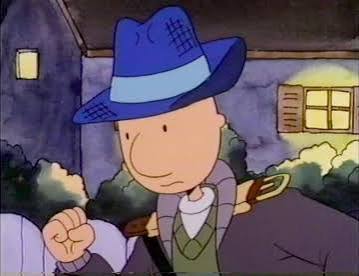
Doug Funnie appears to be an average 11-year-old boy, navigating the transition zone between childhood and adolescence. He lives with his parents and his older sister in Bluffington, a town that also appears to be fairly average. Doug’s best friend is Skeeter Valentine, and together they encounter all the problems facing their contemporaries. There are many other supporting characters in the series, two of the most important are Patty Mayonnaise, the girl who Doug has a crush on, and the school bully Roger Klotz, perpetual menace to Doug and Skeeter.
Doug narrates each episode, and through his drawings often becomes a heroic character in his imagination, like superhero Quailman, international spy Smash Adams (James Bond), and Race Canyon (Indiana Jones). These heroes help Doug assume a new identity, all in his imagination, to help solve the problems of everyday life.
“Doug’s Halloween” exemplifies Doug’s effort to live in two worlds – childhood, a place of safety and predictability, and adulthood, where danger and chaos can appear at any time. Halloween night forces Doug to confront this tension head on. The message is clear, don’t fear the changes coming and observe that Halloween can allow one to embrace both childhood and adolescence at the same time.
The episode begins with narration, but this time it’s Skeeter, telling a spooky story about a cursed house where people may have died; it could have been the “threshold of death”, according to Skeeter. But the house has been purchased by the local amusement park, Funky Town, and now it has become the park’s newest attraction, “Bloodstone Manor.” All kids in costumes get free admission on opening night, Halloween.
While Skeeter is excited to go to Bloodstone Manor, Doug is clearly afraid. At this point in the show, Doug begins his own narration and wonders if he can survive the “scariest ride ever.” He has dressed up as Race Canyon and imagines the two of them fighting the monster of the manor. His fantasy cuts short as the monster defeats Doug and Race. Overwhelmed with fear, Doug tells Skeeter he only wants to go trick-or-treating, “think of all the candy” he points out. Reluctantly, Skeeter argues, “Aren’t we little old for this Doug?” Skeeter finally agrees to trick-or-treat for a period of time and then head to the amusement park. The boys stop at the house of Connie, a classmate, who asks why they’re out. Embarrassed, Doug and Skeeter make up a story that they are only getting candy for Skeeter’s little brother, and the two quickly leave.
To add insult to injury, Doug’s heroic hat blows away in the wind – he is no longer Race Canyon. “Who was I kidding?” Doug says, admitting that he is too scared to go to Bloodstone Manor. Seeing Doug’s fear, Skeeter agrees to skip Bloodstone Manor and they miss their bus to the park.
Everything changes when Patty and her father stop their car and ask the boys if they need a ride. Patty’s praise of Doug’s costume changes everything. She says, “You look just like Race Canyon” which prompts Doug to ask for a ride to the amusement part. Feeling confident after Patty’s comment, he brags that he and Skeeter are eager to go to Bloodstone Manor.
Things go badly when they arrive and find a huge line. By the time they get to the entrance, the park closes for the night. Roger shows up and challenges Doug and Skeeter to enter the ride even though it is officially closed. They decide to accompany Roger into Bloodstone Manor. After a series of scary events in the ride, they are trapped. Doug confronts his fear and decides to take charge and find a way out. Thinking that Roger is lost and needs help, Skeeter wants to leave the bully behind, but Doug refuses, “We have to keep looking. What was I doing running away like a little chicken?”
Ultimately confronted by the mysterious figure who oversees Bloodstone Manor, Doug demonstrates courage and ultimately gains help from him. The three of them work together to frighten Roger and his toadies, forcing them to clean up their night’s vandalism. No longer fearing the manor or its monstrous overlord, Doug and Skeeter can now enjoy the night, even when they learn he’s a real supernatural being.
Doug’s creator Jim Jinkins said that he wanted every episode to have a moral; the lesson in “Doug’s Halloween” must be that fear is something we all experience, and it can be overcome by confronting our emotions and learning to manage them. Doug realizes that courage is more than physical strength and blind faith in self. Instead, courage is the ability to acknowledge what we fear, consider how to respond with common sense, and forge ahead. Halloween is a time to celebrate being a kid and being an adult simultaneously, something that Halloween enthusiasts tend to recognize.
The Adventures of Pete and Pete
“Halloweenie” Season 2, Episode 7
Aired October 9, 1994
One of the most unique Nickelodeon shows, The Adventures of Pete & Pete, is the story of two brothers and their parents in Wellsville, USA.
Pete & Pete is ostensibly a sitcom for kids and families, but it’s truly a series of short comedy films. Each episode has a strong forward momentum in its storytelling, which avoids the traditional back & forth sitcom rhythm, while elevating cinematography and writing far beyond what’s needed. Its wide range of humor can be fully appreciated by both adults and kids, and its 90s alt-rock soundtrack, featuring house band Polaris (theme song “Hey Sandy”), combine to form something wholly original.
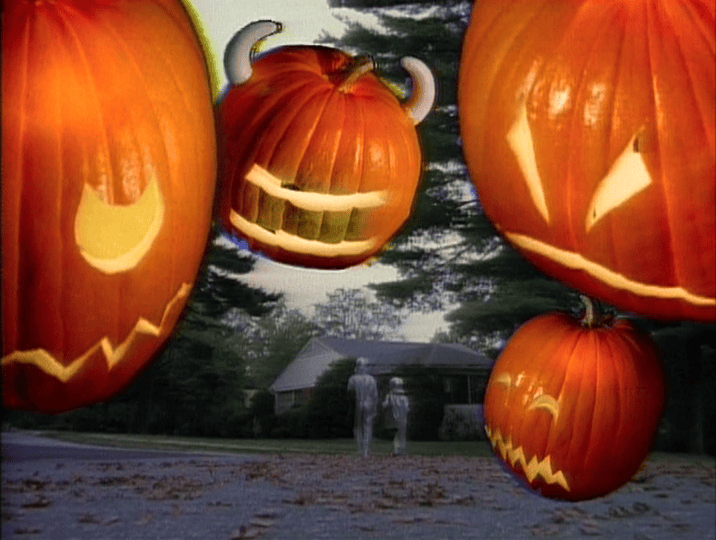
One of its most classic episodes, “Halloweenie”, takes a familiar coming-of-age premise and spins a story that is both funny and touching. The story starts with Big Pete’s narration about outgrowing Halloween. He feels that he is confidently moving forward in life and leaving something childish behind. However, this feeling isn’t exactly genuine. He is afraid of the Pumpkin Eaters, a local gang of Pumpkin-headed bullies who torment anyone they can find on Halloween. The worst treatment is reserved for those who are deemed too old to be trick-or-treating. This is the Weenie Roast, where Halloweenies are tied to a tree, upside-down, and humiliated with shaving cream and public mockery.
As is the case with many holiday specials, Halloween is at risk and must be saved. Frank the crossing guard comedically/ominously warns Little Pete that this might be “the last Halloween” due to the Pumpkin Eaters’ havoc, “Devil’s Night”. Multiple flashback scenes of the Pumpkin Eaters use eerie horror movie atmosphere to quickly characterize them as malicious villains. “Gut buckets!”, Little Pete scoffs. Of course, irony is lost on the Halloween-hating Pumpkin Eaters, who dress up in costumes just like the trick-or-treaters they terrorize.
A lot of great Halloween TV episodes borrow the tried-and-true cinematic premise of “one crazy night” – it’s an obvious fit for the holiday. Trick-or-treating, and Halloween more generally, is at its best, an odyssey into the night. Just like Christmas Eve anticipates the morning, Halloween Day anticipates the night.
But Big Pete may have cursed Halloween by smashing a pumpkin; he’s too cool for the holiday. Halloween-obsessed Little Pete wants to break the local trick-or-treat record of 374 houses in one night. Eventually, Big Pete relents, and the brothers begin their mysterious journey as Neil Armstrong and Buzz Aldrin, symbolizing their attempt to break a glorious record. As the night draws on, it becomes a war of The Petes/Wellsville vs. The Pumpkin Eaters. Just as victory becomes imminent, an encounter with former Weenie Ned Richmond rattles Big Pete.
Of course, The Pumpkin Eaters close in on the lone Pete, who ends up hiding in the Wellsville Haunted House. It’s a sly move on the episode’s part – utilizing light horror atmosphere, but more importantly representing Big Pete’s psychological confrontation with Halloween. He’s cornered in the cellar and must decide whether to join the Pumpkin Eaters or get roasted. Luckily, Big Pete stands up for himself, and the Pumpkin Eaters are apprehended. Big Pete even gets to smash a pumpkin right onto the face of the gang’s unmasked leader (of course it’s Endless Mike, the series’ recurring antagonist). Big Pete has reversed his fate. The episode closes out with “Waiting for October”, another key Polaris song.
Hey Arnold!
“Arnold’s Halloween” Season 2, Episode 7 – Special Half-Hour Episode
Aired October 27, 1997
This show makes it clear from the opening credits that it’s set in a big-city neighborhood with large tenements and urban streets. Although some sources say the show is set in Washington state, it is reminiscent of an old-school urban neighborhood. The city atmosphere is a backdrop that separates Hey Arnold! from almost all other animated shows.
Hey Arnold Episodes are usually 15 minutes each, but the Halloween show is 30 minutes in length and identified as a “special” production. This reinforces its importance for fans who want to build a viewing list of notable Halloween shows from their childhoods.
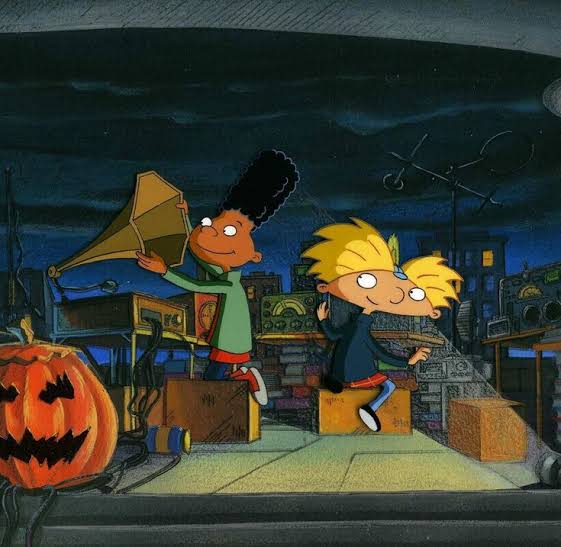
Arnold is a fourth grader who lives with his grandparents in a large boarding house, filled with interesting characters with various personality quirks. Mr. Hyunh is a refugee from Vietnam, Oskar is an immigrant from Eastern Europe, and Ernie is reminiscent of Danny DeVito’s character Louie on Taxi. Arnold lives with his grandparents. Grandpa is an old-timer who runs the boarding house and Grandma lives on the margins, saying little and doing odd things.
The neighborhood is filled with Arnold’s friends, including Gerald (his best friend) and Helga (a girl who acts tough but is secretly in love with Arnold). A number of other kids and adults make up the neighborhood and provide support for Arnold’s adventures.
Halloween is supposed to be devoted to children, but Arnold and Gerald learn that it’s different this year. When Grandpa announces a meeting to plan the annual boarding house Halloween party, Arnold asks if he and Gerald can help. Grandpa is adamant in his rejection: “Halloween is a serious business and it’s not for kids. The purpose of Halloween is to scare the living daylights out of everyone until they scream bloody murder.”
Grandpa loves a good Halloween prank, which gives Arnold an idea. Earlier that day, Arnold was watching UFO Today, a reality television show hosted by renowned UFO hunter Douglas Cain, who believes aliens are likely to appear on Earth on Halloween, then they can blend in easily.
Instead of trick or treating, Arnold and Gerald decide to scare the grown-ups at the party with a great prank, convincing them aliens have landed.
At point, the story shares both childhood fantasy and adult nostalgia. The episode pays homage to Orson Welles and his famous “War of the Worlds” radio show, which aired October 30, 1938, on CBS Radio, frightening listeners across the United States. Douglas Cain is voiced by Maurice LaMarche, a noted voice actor well-known for imitating Welles. Moreover, the name “Douglas Cain” reminds viewers of Welles’ Citizen Kane. Hey Arnold’s Cain is a pompous windbag, pontificating about his greatness as an investigative journalist and possibly the “last award-winning journalist on earth.”
Arnold and Gerald locate an old radio transmitter in the basement and connect it to the large public radio in the boarding house. They plan to present a newscast about an alien invasion; to reinforce the prank, they have stationed their friend Stinky at the city water tower and decorated it with Christmas lights. When lit up, the water tower will appear to be the alien mothership that Douglas Cain has warned the public about.
In a parallel storyline, Helga and the rest of neighborhood kids discuss a group theme for trick-or -treating. Knowing that her father Big Bob loves UFO Today, Helga demands that the group dress as aliens, hoping to impress/scare the adults.
Of course, nothing goes as planned. Arnold and Gerald’s fake newscast about the alien invasion is broadcast on the boarding house radio, scaring the adults at the Halloween Party. But somehow the newscast also goes public and one of Douglas Cain’s assistants picks it up. Once Cain hears it, everything changes. He seizes control of the local television station and presents an emergency announcement that Earth has been invaded. He vows to find the aliens and show the rest of the world what they look like.
At the same time, Helga and her friends are mistaken as real aliens and chased by a mob with pitchforks and torches, in typical monster movie fashion. As they run for their lives, Helga’s father Big Bob takes the situation into his own hands, with a plan to hunt down the aliens as revenge for a supposed extraterrestrial encounter twenty years earlier.
The episode moves to Welle’s Ridge, site of the city water tower, for the final act. When Stinky turns on the water tower Christmas lights, they blow the entire power grid, leaving the city in darkness and panic; the only thing visible in the night sky is the mothership. All the characters converge on the ridge: Douglas Cain with a live newscast, Helga and her friends seeking safety, Big Bob on a mission to destroy the mothership, and Arnold and Gerald, driven by Grandpa who realizes it’s all a hoax.
In the show’s climax, Big Bob grabs Helga, unrecognizable to him as an alien, and begins to “wring her scrawny neck.” At the same time, Bob’s friends launch a bag full of beepers at the mothership to destroy it, successfully breaking the water tower open. With water pouring down and Helga’s face paint dissolving, Big Bob realizes the truth. Arnold explains the prank, and Douglas Cain has little to say.
Hey Arnold! speaks to children on two levels. First, it addresses the dichotomy of Halloween: is it a holiday for kids or a holiday for adults who want to be kids? In some ways the episode suggests that Halloween should be for kids first – adults can participate but should not capture the holiday for themselves. This episode also suggests that Halloween should center, above all, on fun. Once it becomes too serious, as it was for Big Bob, Douglas Cain, and the adults in the boarding house, the energy and spontaneity of Halloween vanishes.
For children growing up with Nicktoons in the 1990s, “Arnold’s Halloween” is a wonderful way to remember what Halloween stood for in the kids’ universe.
Angry Beavers
“The Day the World Got Really Screwed Up (An Angry Beavers Film)” Season 2, Episode 10
The Angry Beavers is an essential 90s Nicktoon. It’s funny and inventive, blending many different types of humor – silly, witty, slapstick, and more. It exemplifies what set Nicktoons apart from children’s programming in the 1990s. Beaver brothers Norbert and Daggett live on their own in a new dam, after moving out from their parents’, getting into all kinds of misadventures.
“The Day The World got Really Screwed up (‘An Angry Beavers Film’)”, is a tribute to 50s horror and sci-fi B-movies. Its guest star roster includes Peter Graves, Adrienne Barbeau, William Schallert, Jonathan Haze, John Byner (a well-known comedian from the 1970s), and Tom Kane (a prolific voice actor). Three actors stand out as Hollywood veterans, who many adults will be familiar with.
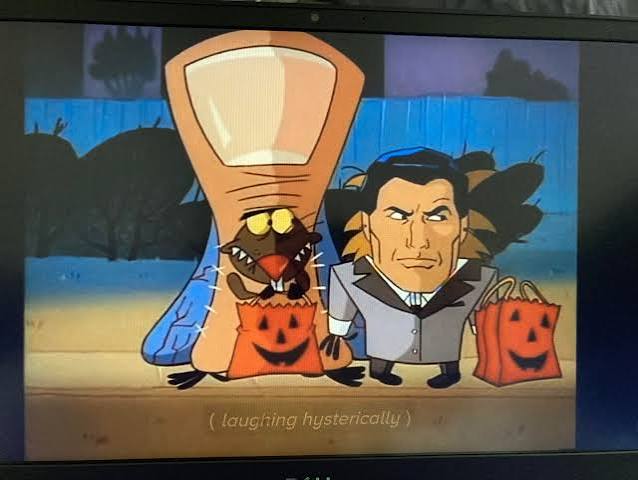
Beginning in the 1970s, Barbeau appeared in multiple television programs, films and plays. She gained acclaim for roles in sci-fi classics such as The Fog, Escape from New York, Creepshow, and Swamp Thing.
Graves had a long career, often appearing in B-movies. Best known for television’s Mission Impossible (1967 to 1972), five of his films were riffed by the Mystery Science Theater crew. He appeared in the popular film comedies Airplane and Airplane II, and in the 1990s was the narrator for A&E’s Biography series. He hosted a Biography spoof as part of the storyline in Men in Black II.
Schallert appeared in almost 400 television and film roles for more than six decades (1951 to 2014). Appearing in many B-films and television shows as a guest star, he was an “everyman” figure, playing supporting roles and becoming the face, but not the name, that viewers could recall.
In this Angry Beavers B-movie tribute, we find the brothers trick-or-treating (the day before Halloween). Daggett believes that going early will reduce competition and net more candy. Daggett is dressed as The Crawling Spleen, and Norbert wears a mask to portray B-movie star Oxnard Montalvo. Miraculously, they quickly end up at Montalvo’s 1960s Hollywood Hills styled estate, a huge and scary mansion. The beavers sneak into the mansion and everything is off. A meteor has hit the earth, first infecting Oxnard’s butler, appropriately named “Man Servante”, then eventually the meteor animates all the monster statues inside Montalvo’s home. The beavers are too focused on themselves and getting candy to notice the danger.
The beavers encounter three people apparently trying to save Earth from attack. The great B-movie actor Oxnard (Kane), a dim-witted scientist Dr. Cowtiki (Schallert), and the beautiful assistant Taluca Lake (Barbeau).
The animation style of this episode blends in a comic book look for Oxnard Montalvo’s estate, the human characters, and the alien creatures. This also plays into the comedy – the humans don’t know what the beavers are – they call them “little pointy animals”, for example. Oxnard is the caricature of classic Hollywood leading man, handsome with a commanding voice, but offering no real help, just trite cliches in response to danger. Dr. Cowtiki and Taluca Lake are just as clueless in dealing with danger.
The stilted and cheesy acting and writing of low-budget cult movies is lovingly referenced throughout the episode – “anything’s possible…if it happens”, Oxnard remarks, trying to explain the alien invasion. “Destroy them until they’re dead”, a possessed Man Servante demands of a Golem-like statue.
The alien must feed on reality, which turns everything but the beavers to black-and-white. The humans are unable to fight back and the monsters start to destroy everything in sight.
Eventually, the beavers battle the ultimate monster using a device called the “mindulator thingy”, returning color to the world. General Warning (Graves) and the U.S. military also support the beavers in fighting the monsters, “Shoot little missile thingies at it and make it go away!” General Warning orders. The episode also uses old films clips of planes and bombs to add to the action and comedy. The beavers save the day for humanity and head back to trick-or-treating, unaware of exactly what they have achieved.
The Angry Beavers, and especially this Halloween episode, offer silly and offbeat stories that can engage children and at the same time present sophisticated humor that speaks to adults. This is one reason the show is entertaining when the children of the 90s become adults in the 2000s. Viewers should also watch “Food of the Clods” for another, non-Halloween, Angry Beavers B-movie tribute.
Reference: Chris Morgan, The Nickelodeon ’90s Cartoons, Game Shows and a Whole Bunch of Slime. McFarland Press, 2021.
We also recommend YouTube channel AV Pop Culture with Chase Smith, which has partially inspired our celebration of Halloween this year.


